


Don’t Get Snared By the Bear Market Rally
By Jeffrey A. Hirsch
The Stock Trader's Almanac
http://www.stocktradersalmanac.com/
Now that practically everyone is either talking about or expecting a full-blown recession and bear market, it is less likely that the market will plummet to new lows in the coming days or weeks. Markets tend to collapse when the least amount of people are talking about it. This economy and market are far from secure against contraction and further decline, but at this juncture a bear market relief rally seems to be taking hold. In addition, the Bush administration, lawmakers on Capitol Hill and the Federal Reserve are conspiring to pull out all the stops to stave off any sustained economic contraction with rate cuts, the stimulus package and now the housing market bailout with the new “mortgage initiative.”
In the short run this may mitigate any market fallout as hope springs eternal.
However, in the long run, if the economy is going to contract, anything the government does won’t prevent it – though it may speed up a recovery and minimize the pain of a slowdown. But, as we examine in the Proving Grounds on pages 6-9 (Reserved for Subscribers), all this stimulus falls short of addressing the real problem with recession: job creation.
Nasty January
The results are in and they were not pretty. Our January Barometer gave a negative reading as January 2008 was one of the worst Januarys on record. Even with the impressive 5.2% rally in the S&P 500 the
last seven days of the month, it still lost 6.1% for the month. This was the sixth worst January in history for the S&P since 1930.
The Dow’s 4.6% drop was the fourteenth worst since 1901 and NASDAQ posted its worst January since it was created in 1971. The January Barometer’s record in election years provides some solace. Since 1950, election years have followed January’s direction in 10 of 14 years with the four errors occurring when January was down. Two down election year Januarys were followed by full-year declines in 1960 and 2000. When January has been down in election years full-year market performance has been unimpressive. Of the six election years with down Januarys none produced a doubledigit gain and on average the S&P gained a
paltry 0.5%.
However, the important thing to remember here is not at what level the market closes the year, but what happens in the interim. Down Januarys do have a remarkable record. Since 1950, every down January has
been followed by a new or continuing bear market or a flat year with an average decline of 12.6% from the end of January to the subsequent low for the remaining eleven months. Page 42 in the 2008 Almanac details this record.
We are not in “official” bear market territory at this point but we’d be surprised if the current downtrend does not morph into a real bear market. At a bare minimum we expect the market to be flat for the year. On
top of the negative January Barometer a host of other readings were quite ominous.
The Santa Claus Rally failed to materialize, the First Five Days were down and the December Low Indicator was triggered on the first trading day of 2008. In fact the first three weeks of the year were the ugliest
opening to a year in recent memory. Also, the Year’s Best Three-Month Span, November to January was atrocious. The last three months rank in the ten worst periods across the board. However, this is only the
fourth time since 1901 that the Dow has been down in each of these three months in a row.
The previous three instances 1932, 1942 and 1970 were in the midst of nasty bear markets nearing their ends. Major bottoms occurred in July 1932, April 1942 and May 1970. Though these previous bears had been in progress for over a year, this troika of monthly losses preceded a major bottom within six months. We just may have to wait a bit longer for the next massive buying opportunity.
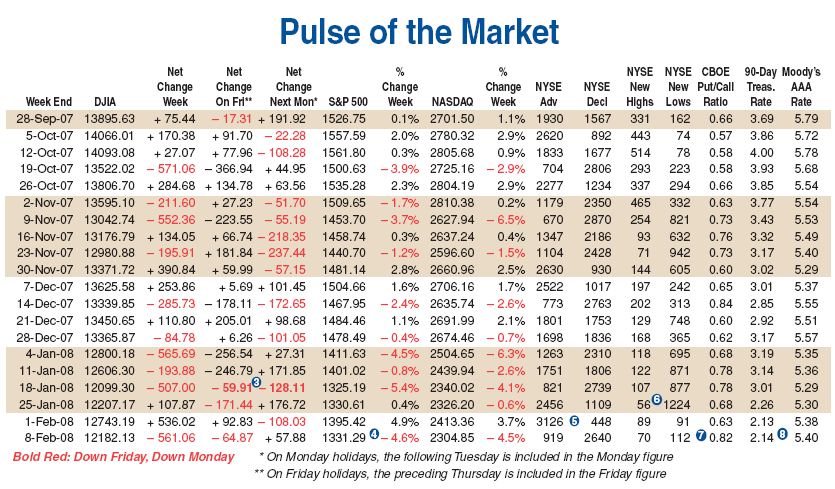
Pulse of the Market
In the Dow chart below you can see that the 200-day moving average (red line) has turned down [1] . This is a further indication that we are in a protracted downtrend. At the beginning of the year the 50-day MA
(black line) slashed through the 200-day as the downturn took hold. The pattern of lower highs and lowers lows continues and may become even more dramatic if the market is unable to push through the resistance
at the dotted line and fails to close above the February 1 high.
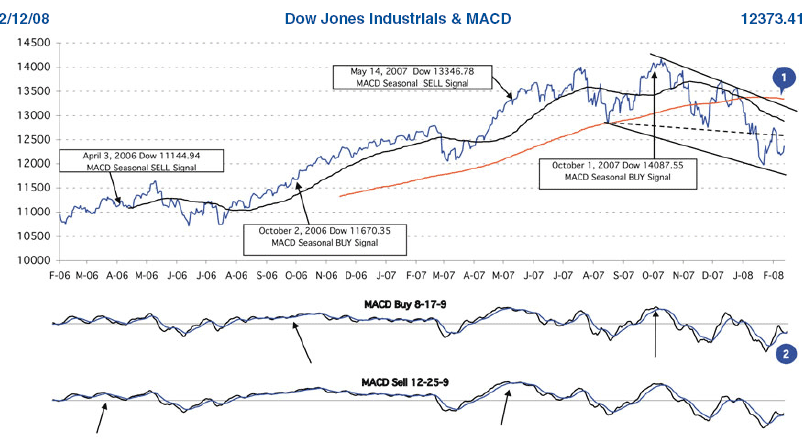
The market was able to find support at least temporarily at the January 22 lows just below 12000. As we anticipated in our 2008 Annual Forecast in the January issue, this was a solid test of the 2007 lows. From
there the market rallied for about a week and you can see in the MACD indicator [2] that this was a positive shift in momentum.
The market is struggling to sustain this momentum as MACD never reached the zero line and the Dow has yet to log a higher high. We suspect the January lows will be tested again before the January highs. Our first Down Friday/Down Monday of 2008 [3] marked the low point of the year so far. It came in the midst of four down Fridays in a row. All but one Friday in 2008 has been down. This stampede to the exits is not encouraging. After two weeks of relief stocks sold off sharply again last week [4] as recession fears mounted.
The internal numbers have showed a glimmer of hope as advancers outpaced decliners by a seven to one margin two weeks ago [5] , the largest margin since May 2004. This came the week after there were 1224 new lows [6] that capped off 15 weeks of massive new lows. This all adds up to an oversold position that markets tend to rally from.
However, fear has not truly been instilled in the eyes of investors. The weekly CBOE equity only put/call ratio only peaked at 0.82 [7]. This is a much less frightened number than the 0.91 reading back in mid- August or the 1.00 level indicating the kind of rampant fear associated with major bottoms. Finally, the yield spreads have the largest margins since December 2004 [8] as the yield curve has steepened dramatically.
On the surface you might think this immediately means were on the road to recovery. But, Mark Kiesel of PIMCO as quoted in Investor’s Business Daily reminds us that, “The steepening yield curve means that the economy is slowing.”
The decline since the high in October has been driven by the dismal readings we’ve been getting from the economy and corporate America. Corporate earning have been generally lackluster, outlooks bleak and layoffs plentiful. The unemployment rate is rising and job creation is slowing. Consumer confidence is at its lowest level since 2003 and retail sales are uninspiring.
March Almanac
March is historically stronger earlier in the month and weak later in the month. Shellackings in 2005, 2004, 2001 and 2000 for NASDAQ, have driven March’s performance down in the monthly rankings. In election years the vernal month has been troublesome for stocks as primaries hit the critical phase. It is the worst month for NASDAQ in election years and no prize for the other indices.
The week after Triple Witching has quite a propensity for market slaughters. In election year 2000, the bear market began in March 2000 for NASDAQ and the S&P. The Monday before Triple Witching is solid with
the Dow up 15 of the last 20 years, which happens to be Saint Patrick’s Day this year, though the market has performed better on the day before the patron saint’s holiday. When Good Friday lands in March, as it
does this year, the day before is much worse.
And the day after Easter is the worst post holiday trading day with the S&P down 10 of the last 14. Refer to the March Strategy Calendar on page 16 for more of the nitty gritty on March. It still pays to heed that
infamous warning to Julius Caesar and “beware the ides of March” as most of the trouble in March has come after mid-month.
# # #


