

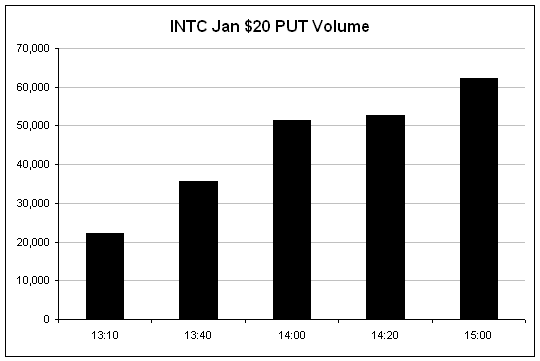

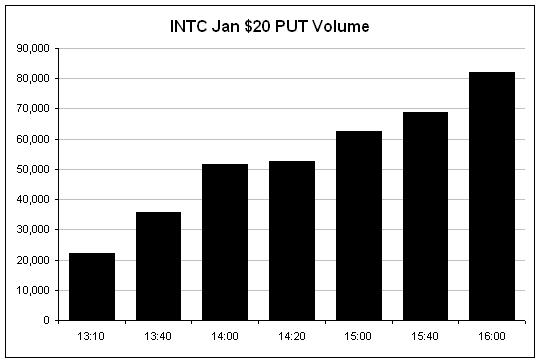
INTC Jan $20 PUT Volume
Started by
TechMan
, Jan 14 2010 03:11 PM
6 replies to this topic
#1

TechMan
-
- Traders-Talk User
- 7,663 posts
Member
Posted 14 January 2010 - 03:11 PM
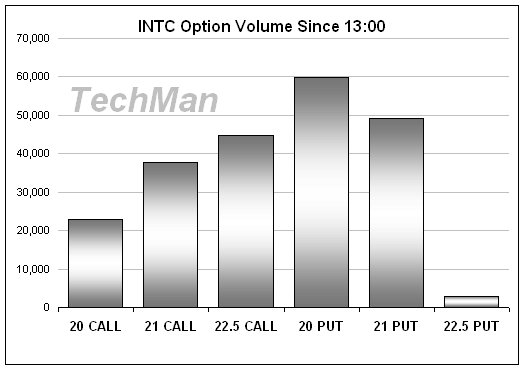
Since 1:00 pm...
Odds are 50/50 (neutral) that this INTC report will be a market moving event, but there seems to be quite a bit of interest in these $20 PUTs that expires tomorrow.
#2
TechMan
-
- Traders-Talk User
- 7,663 posts
Member
Posted 14 January 2010 - 03:25 PM
I meant expires AFTER tomorrow, not tomorrow, but you know that.
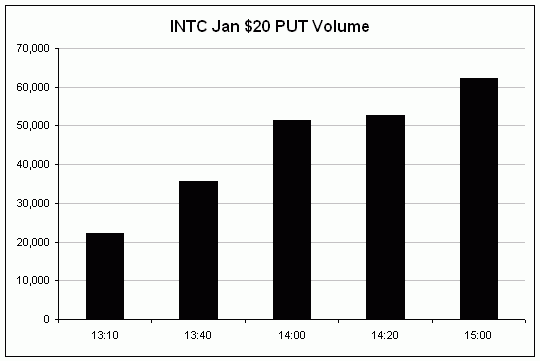
And, for the sender of the last private message, I made up this chart myself...
Have a great trading day ya'll...
#3
dTraderB
-

- Traders-Talk User
- 22,585 posts
Member
Posted 14 January 2010 - 03:31 PM
Seems like many are STRADDLing --
Just to add that the volumes of the JAN and FEB calls are also rising fast...and in some cases are far greater than the call volume...e.g.
JAN 21 call -- 78K
Jan 22.5 call -- 72K
CALL volumes much higher
20 put -- 13k
FEB 21 call - 45K 21 put -- 14K
Feb 22 call - 57K
FEB 23 call - 33k
#4
TechMan
-
- Traders-Talk User
- 7,663 posts
Member
Posted 14 January 2010 - 03:35 PM
CALL volumes much higher
Incrementally, this Jan 20 PUT added the most so far...
Alright, that's it for me.
#5
TechMan
-
- Traders-Talk User
- 7,663 posts
Member
Posted 14 January 2010 - 05:38 PM
AH price now dipped below 21.65 and approaching 21.60... Perpahs those $20 Put buyers got it right. It may gap down tomorrow.
FINAL TALLY
INTC Jan $20 PUT totaled a tad over 80,000 contracts by EOD.
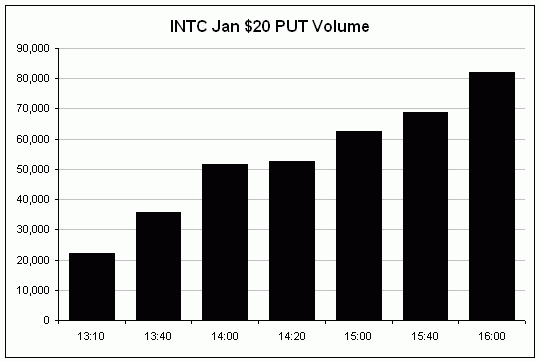 Since 1:00 pm it had added close to 60,000 contracts (tallest bar).
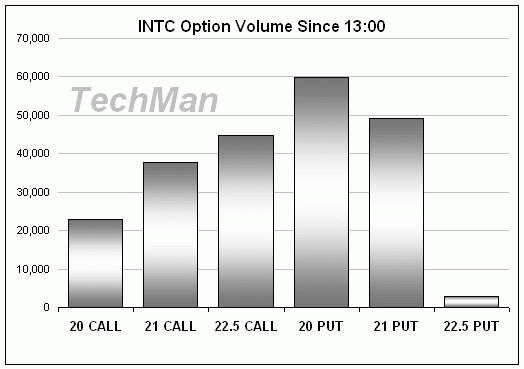
 Since 1:00 pm it had added close to 60,000 contracts (tallest bar).
#6
Jhoe
-

- Traders-Talk User
- 481 posts
Member
Posted 15 January 2010 - 01:52 AM
OK, obviously the report came out and it was what it was, so not to play monday mornng, or early friday morning, QB here, but the options volume, especially in the widely held DOW/S&P stocks can be misleading in two main ways. First, on a stock like INTC the day of earnings AND the day before options expiration, most of the put volume is going to be protective. I mention the fact that it was the day before expiration because that explains why volume was heavy in both front and back month puts. If you think about it, makes perfect sense--if you just got long recently you probably bought Jan puts and then quickly sold today to transfer to the back month. If you were already long coming into 2010, maybe you already owned both months, or just January. In either case, you're going to sell the puts the day before expiration, and hence rack up more volume in the front month, if you're bullish on the stock, not bearish. Actually I believe its more a matter of price vs protection, and some traders might want the protection up until Friday afternoon, others may be confident enough on the day of earnings to get rid of an option about to become worthless and roll that cash into back month or further out. So the point is not only are these mostly not bearish bets, the volume is inflated by all the shuffling around, and while likely not so in the case above, in less popular stocks I've seen puts at 3-5 different strikes, 3 or so different months, go flying around all day and if you stop to add up the cost/proceeds from trades, you can see its one trader adjusting positions for 2010.
The second reason put action is misleading is the lack of volatility in this market. Really, this just supports the case that puts are being used as protection, and traders either use a short sale when they're actually bearish on a stock. I think thats another reason this market is so strong--the cost of options has come down dramatically as volatility has been sucked out of this market. Even when the vix was around 30 middle/early of 2009, and above 30, options were already half the price, often far cheaper by 200 or 300% than same time the last two years. That translates into a strong market because anyone who picks up a chart can see that alot of money came into the market in 2009, especially pre-May. And typically you see that money come out, go back in, come out, etc. But its not doing that...money came in and its staying in. mgrs are chipping away at their positions or tacking some on here or there, or even initiating new positions. I think the number of institutional sales vs buys on an aggregate basis finally swung away from the majority being buys in Q4 (cant remember the source, but will post link if possible) to being slighly higher on the sell side. But to think that after 10 months of a rally as intense as this one that institutions are still opening up many many new positions, and barely being outnumbered by profit takers even into years end, sort of bewilders me. But thats 1 reason why the corrections have been shallow. Protection is cheap, funds really have no similar risk/reward asset class to dive into at the moment and banks have nothing better to do with money than invest in equities as long as the business of lending money isnt too favorable (short term at least, longer terms are actually looking quite good for banks lol). So money comes in and parks there, and you're not seeing the corrections you typically get when the sell signals flash or RSI/STK looks overbought. Theres no pressure to sell, and fund managers all probably feel like Rocky Balboa after coming roaring back in 2009 after a number of lousy years towards the end of the decade. Of course a monkey picking tickers out of a hat couldve probably run a fund that gained 50% or better if they started after Q1 right?
Also, want to point out this action was in no way unique to Intel. I saw it in just about every equity I traded this week, all week long, not just today. For long term investors, and funds, this was a very popular expiration month to hold in their positions, and most spend the first few weeks of a new year looking for chances to roll that protection out. Its misleading because it essentially ups the p/c ratio and creates a steady flow of put volume as traders sell puts into stock weakness (ie strength) and look to buy back month and/or later when the stock is up (ie today). Matter of fact, if you look at intraday put volume, you'll even see put volume picking up when the stock is down which is not too typical as traders "salvage" some cash and roll it out.
I happened to see a very interesting example of this on Thursday--in a name I just got long last week, BX, Blackstone Group. Around 3:15 someone fires off a trade of 8,040 January 15 puts contracts while BX is trading around $13.50...so either this guy/gal thinks BX is going to tank any second or, as I said above, they're expecting a strong close and selling their front month puts into stock weakness and exchanging them for puts a little further out. Sure enough, less than five min later, another large put trade, this time its the March 15 puts, and the trade is for 7730 contracts. Interestingly enough, the January puts sold at the bid price of $1.30 while the March options spiked price as the buyer paid the ask, again just confirmation that the jan contracts were likely a sale and the march contracts were a trader initiating a new position long puts. The March puts BTW traded for $1.80.
This is why its interesting, in between the option trades, someone sells 31,000 shares of BX @ $13.50, collecting just over $400k for the sale. Now here is the amount collected from the sale of front month puts, $1.045 million and the amount paid for the March contracts: $1.43 million. The stock sale generated the extra cash to protect the slightly smaller position, so this trade basically exchanges stock shares for a few months of additional put protection. Of course, 31k, or 310 contracts, is exactly the difference in the number of actual puts bought in each trade too, with the March buy being for a slightly lesser amount. Anyhow, a perfect example of a pro/MM managing a position well, and selling some shares fund a jump out to March in the money put protection.
edit to add: I am watching march activity closely though, as just from what i've been seeing, the p/c ratio is clocking higher in that month than any other 2010 month so far. Of course, this is also due to puts being sold and then repurchased out a few months, but IMO any deviation like that is significant and bears monitoring.
Edited by Jhoe, 15 January 2010 - 01:59 AM.
#7
TechMan
-
- Traders-Talk User
- 7,663 posts
Member
Posted 15 January 2010 - 06:26 PM
Hi Jhoe,
All I can say is WOW...
In any regard, it took me a while to read through your essay, but the detailing of your thought process is much appreciated.
Have a great weekend.
All I can say is WOW...
In any regard, it took me a while to read through your essay, but the detailing of your thought process is much appreciated.
Have a great weekend.


