



June 14, 2006.
For the most part world-wide markets are at new correction lows in their declines.
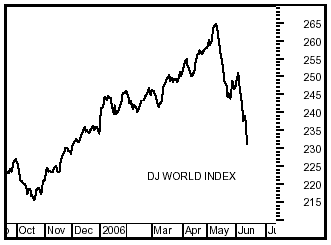
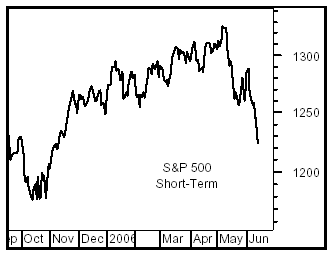
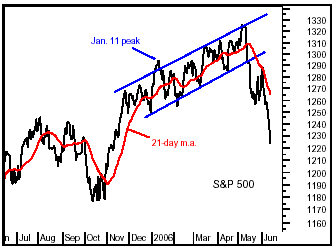
The declines look large on short term charts such as those above. So, the prevailing thought is already that ‘the’ bottom must be near, and the prevailing goal is to catch that bottom. However, a look at intermediate term charts shows a quite different picture, revealing the decline so far has amounted to only a short-term pullback, similar to the other 5% to 7% pullbacks in the S&P 500 of the last couple of years.
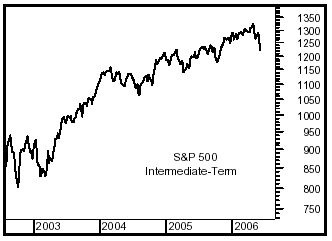
If our intermediate-term sell signal, and the rest of our work, is correct, that after only minor pullbacks in this unusually non-volatile bull market, we are finally in for an intermediate- term correction, usually 10% to 19%, then the odds are for still lower prices. And what if the bull market has ended, as our work also tells us to expect? Then note how minor the decline looks so far on long-term charts like the one below.
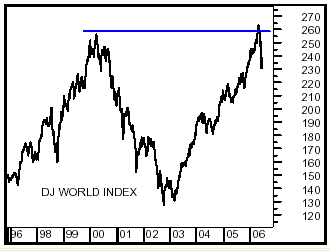
So either way, whether we are only in an intermediate-term correction in an ongoing bull market, or in the beginning stage of the next bear market, looking for a bottom after only a 7% decline in the Dow and S&P 500 looks to be premature. However, just as intermediate term rallies, and bull markets, don’t move in a straight line up, but have periodic pullbacks and short-term corrections, intermediate-term corrections and bear markets don’t move in a straight line down. There are periodic short-term rallies, either in response to an event, an economic number, or more often, due to a short-term oversold condition. We had an oversold rally a few weeks ago, and once the oversold condition was worked off the downside resumed to new correction lows. Now, once again the resumption of the downside has been so swift that the major indexes have again become short-term oversold to the point where another oversold rally should be expected.
The problem with such rallies is that they play into the thought that ‘the’ bottom is in, keeping investors either fully invested, or buying ‘the bottom’, rather than looking on the rallies as another opportunity to lighten up and increase downside positioning.
Are ‘defensive’ holdings enough?
With major indexes having now broken successively below each of the levels that Wall Street hoped would provide support, and now having broken below what most would consider the last hope of it being only a short-term pullback, their long-term 200-day moving averages, many of Wall Street’s previously bullish spokesmen are conceding that at least an intermediate- term correction is underway. However, like most newsletters, most of Wall Street’s spokesmen, even when expecting a correction is underway, try to get through those declines, and even bear markets, by recommending ‘defensive’ holdings; stocks and sectors they say should hold up better (lose less) in a market decline.
So there tends to be, as is going on now, a lot of portfolio ‘adjusting’, selling stocks and sectors deemed to now be risky, buying others thought to be defensive. Obviously, that is not buy and hold investing. So, since their idea is to replace current holdings with other holdings anyway, we don’t understand why the replacements should be holdings merely expected to hold up better (decline less), rather than downside positions designed to make profits in a market decline.
The theory regarding g ‘defensive’ stocks and sectors is always the same, that even in an economic or market decline, “People will still have to eat, will still have to take their medicines, will still smoke, and drink.” So lists of defensive stocks are always dominated by beverage, drug, food, and tobacco sectors.
The theory makes sense.
The definition of a defensive company is one whose business remains stable under changing economic conditions. The company’s business doesn’t grow much faster when economic conditions are robust, but neither does their business suffer much when economic conditions turn sour.
That makes them good places to work. Their employment needs do not fluctuate much with economic conditions. However; Their stock prices do fluctuate. Their stock prices fluctuate along with the rest of the stock market simply because in a rising market investors are more willing to pay higher prices for a given amount of earnings than they will pay in a declining market when they are less confident.
So a company with earnings that amount to $1 per outstanding share may sell at $30 a share in a rising market (a P/E ratio of 30). However, in a declining market, even though its earnings remain stable at $1 per share, the share price may plunge 30% to $21. Why so? Investors, less confident, are no longer willing to pay 30 times earnings, but only 20 times, or less. So be careful in accepting as gospel the theory that shifting to defensive stocks will protect a portfolio in a market decline.
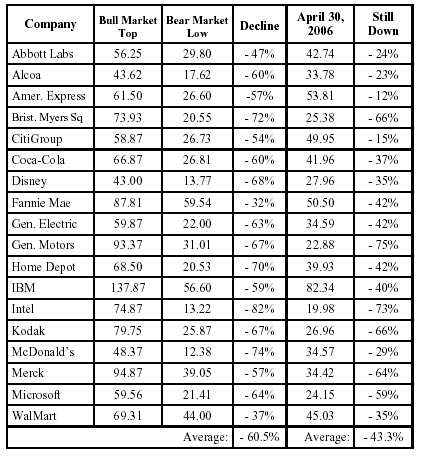
The following is a table we showed you a couple of months ago. It may have more meaning now that a market decline has been underway.
It shows some of the defensive ‘safe haven’ stocks most recommended by Wall Street near the top of the last bull market (1999-2000), their subsequent bear market lows, and how much they are still down six years later.
STS received its official exit signal on May 12, signaling that the market is now in its unfavorable season until next fall. Its timely entry was October 24. We will be using downside positioning for at least part of the unfavorable season in the Aggressive Seasonal Timing portfolio, while the normal STS portfolio usually only switches to cash for the unfavorable season, (although we may switch some of it to a bond fund if our bond buy signal is confirmed).
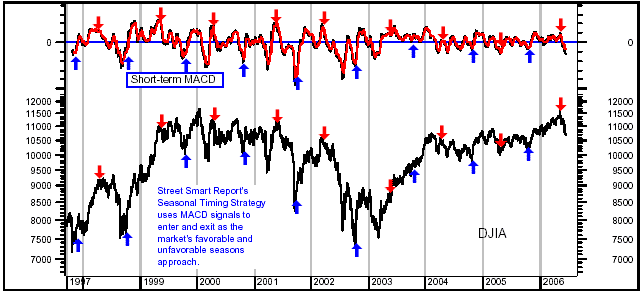
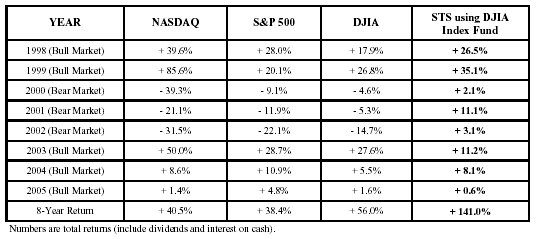
To what degree STS will out-perform the market this year will depend on how much lower the market is when STS re-enters in the fall. At this point the DJIA and S&P 500 are down roughly 5.3% since our STS exit. We opted not to follow the rules of our STS Strategy this year, due to the risk that the serious market correction we expect this year might begin early. So we took our STS profits early, on Feb. 6. Those who chose to stay with the rules of the strategy exited on the official STS sell signal of May 12. The S&P 500 was 2.3% higher than at our early exit, and we made less than 1% from interest on cash in those three months. However, whether the extra 1.5% available by staying in was worth the risk is debatable. By exiting early we under-performed the simplicity of the mechanical STS strategy. In spite of the negatives that developed after January, the market held up to the end of its favorable season as defined by our STS strategy. In fact, the official STS exit signal took place just two days after the Dow hit its peak of 11,642 on May 10. The following table shows the 8-year performance of the STS strategy, if followed by the rules, entering and exiting 100% on the official MACD signals, and using the DJIA Index as the holding on each entry. Although under- performing the market in 2003, it was still up for the year, and unlike the market had no down years (since most of the damage in market corrections, even in bear markets, takes place in the market’s unfavorable seasons).
The consensus of the 35 intermediate-term technical indicators we utilize deteriorated to a sell signal on Feb. 3. As a result we took our profits on most holdings, but did not take downside positioning, waiting for it to become more clear whether our sell signal was correct or not.
Negative divergences developed, with the tech sector, utilities, and Nasdaq 100 going into corrections. But the Dow and a few other indexes only moved into sideways trading ranges, with an upside bias by which they made several fractional new highs, but highs that had no follow through. The fractional new highs kept the S&P 500 at overhead trendline resistance, but which it was unable to break through, while the negative divergences combined with rising interest rates, the bursting real estate bubble, etc. convinced us that playing the long-side in such a flat market would be a losing situation sooner rather than later. Meanwhile, we had been making double-digit profits away from the general market, in gold, the energy sector and Japanese market, while awaiting the time when we could take downside positions on the U.S. market.
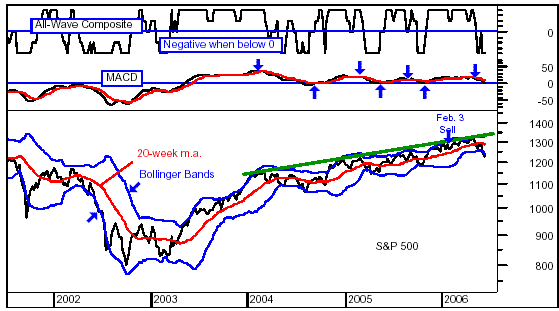
With the confirmation of renewed sell signals on key indicators, and the end of the market’s favorable season, as indicated by the exit signal triggered on May 12 by our Seasonal Timing Strategy, we had the downside confirmation we had been waiting for, and moved significantly to downside positioning on May 16. The S&P 500 subsequently broke below its important intermediate-term 20-week m.a. for the first time since last summer, into the usually bearish lower half of Bollinger Bands. Short-term rallies notwithstanding we believe the significant decline we have been expecting in the unfavorable season of this, the usually negative 2nd year of the 4-Year Presidential Cycle, has begun. We expect it to produce an important low in Oct./Nov. But not in a straight line down. There will be rallies. AND: Short-Term (chart at left). The initial plunge had the S&P very oversold beneath its 21-day m.a., and we told you to expect a brief oversold rally back up to the m.a. That rally took place, and failed at the m.a., establishing the m.a. as likely overhead resistance for the next short-term oversold rally. With another spike-down since, the S&P 500, is again getting oversold beneath its 21-day m.a., making another short-term rally likely.
NASDAQ. The consensus of our technical indicators on the Nasdaq also remain on the sell signal of Feb. 3. The Nasdaq has been in negative divergence with the Dow (and the other indexes that made periodic fractional new highs), since the market peak of January 11, which was the high for the year for the Nasdaq 100 (not shown).
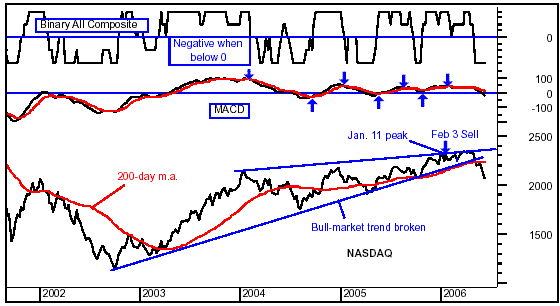
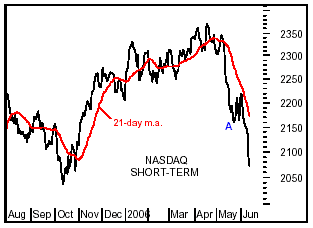
The Nasdaq broke below its important 30-week moving average (not shown), then broke below the trendline support of the entire bull market from the 2002 low, and now decisively below its long-term 200-day m.a. The intermediate-term technical indicators remain on the sell signals, and most have a long way to go before they would be as oversold as they could get in a bear market-type decline. with other major market indexes and sectors, the swiftness of the initial plunge had the Nasdaq quickly short-term oversold beneath its 21-day m.a. at point A. We told you to expect a brief oversold rally back up to either the 21-day or the 50- day m.a., and that such a rally would be a 2nd opportunity to lighten up and take downside positions. The rally did take place, in which the Nasdaq retraced about one-quarter of its previous decline. The rally ended once the Nasdaq touched the resistance at its 21-day m.a., and the downside resumed.
The swift plunge since has the Nasdaq, like the other market indexes, again approaching a shortterm oversold condition beneath its 21-day m.a. That does make it likely we will soon see another attempt at a rally. Such a rally attempt might even become a typical summer rally of 5% or so. However, with the 21-day m.a. now moving down almost as fast as the Nasdaq itself, such a rally may not amount to much more than the previous one from point A.
Intermediate-term the bullish picture doesn’t have much going for it at this point. The market is now in its unfavorable season in which it suffers most of its losses each year. It is in the 2nd year of the Four-Year Presidential Cycle. The first two years of the cycle tend to be negative, the 2nd year especially when the first year did not have a big correction. Wall Street and the Fed are finally acknowledging that inflation is a threat that requires still higher interest rates. Realtors are finally admitting the real estate bubble has burst. Soon will come realization that consumers, which account for 65% of GDP, carrying record debt, with higher interest rates and the wealth affect disappearing from their homes, will not be able to maintain even close to previous spending levels. Rising inflation - slowing economy - Flattening yield curve - Recession ahead?
Gold Bullion. Our indicators remain on the timely sell signal of May 15.
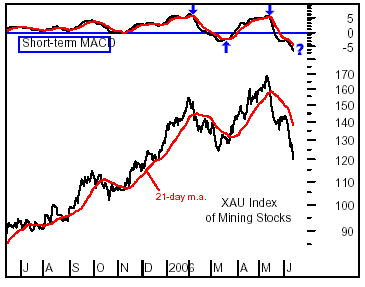
It was triggered just three days after the XAU Index of Mining Stocks reached its peak of $168.62, and just two days after bullion reached its peak of $725 in May. Our downside targets were $575 an ounce for bullion, and $110 for the XAU Index of Mining Stocks. Bullion closed at $563 an ounce yesterday, and was as low as $542 an ounce in overnight trading (night trading not shown on chart). In doing so it reached the important potential support at its 200-day m.a., where the m.a. is also coincident with the 38.2% Fibonacci Retracement Level.
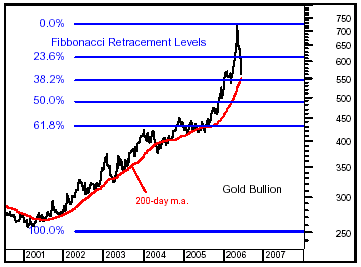
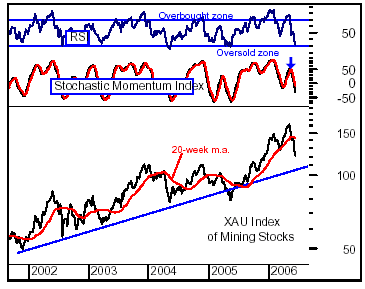
As we had been pointing out, bullion has a history, whether in a bull or bear market, of returning to its 200-day m.a. at least once every year. In its parabolic spike up of the first three months of the year, gold became so overextended above the m.a. that a dramatic decline seemed inevitable. Gold has subsequently plunged $183 an ounce (to its overnight low at $542 last night).
The reaching of the two potentially important support levels, coupled with the short-term oversold condition of the XAU Index of Mining Stocks (bottom chart), is enough to have us watching closely for a possible bottom. Such a bottom, when it arrives, is not likely to be a Vee bottom, but a case of backing and filling and forming a base. But we expect to act quickly to take our profits when it comes. So stay tuned to the hotline!
XAU Index of Mining Stocks. The XAU has not reached our downside target of $110. However, it declined 29% from its peak of 168.62, to its close yesterday at 120, in just 5 weeks. An important question is whether the gold stocks have decoupled from the bullion and will move with the rest of the stock market. The decline has it very oversold beneath its 21-day m.a. again, and a rally back up just to test the potential resistance at that m.a., currently at 138, would take back a lot of our current profit on the short-sales.
That is another reason, along with bullion having reached (and exceeded) our downside target, that we will probably be quick to take our short-sale profits.
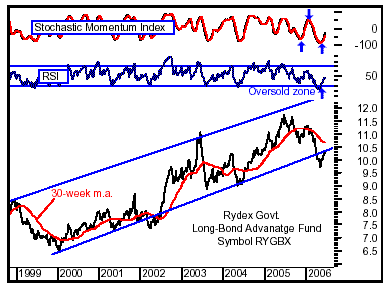
U.S. Treasury Bonds. Our indicators remain on the recent buy signal of May 24 for bonds. Our indicators primarily detect whether money is flowing into a market or out, as well as when the momentum changes direction, without regard to what is causing the change, or who the primary participants might be.
That bonds are going up in price when interest rates are rising is again a bit of a conundrum (to use Alan Greenspan’s description of the phenomenon when bonds rallied so strongly for more than a year after the Fed began raising the Fed Funds rate in 2004).
We do need to see more confirmation of the reversal to the upside, which would include the ability to rise back into the rising trading band, as well as above the overhead resistance at the 30-week moving average.
Additional Comments: The market received more bad news on inflation this week. The Producer Price Index, and Consumer Price Index, both showed that inflation rose significantly more than the consensus forecasts in May, for the third month in a row. That pretty well guarantees more interest rate hikes by the Fed. As unacceptable as it was at the time, it does look like our forecasts as far back as 2004 when the Fed began this series of hikes, that the Fed Funds rate, then at 1%, would have to reach at least 5.5% before the Fed could end the hikes, will be correct.
Another hike of 0.25% at its June meeting is now assured, with more hikes very likely at future meetings. In fact, don’t be surprised, given the unexpected jump in PPI and CPI in May, if the Fed gets more aggressive and hits inflation (and the markets) with a 0.5% hike. In most every previous rate-hiking cycle it did become more aggressive after a string of 1/4% hikes failed to get the job done, and inflation continued to rise. The market is correct to be nervous. A slowing economy and rising inflation = ‘stagflation’, not seen since the terrible 1970s.
About Sy Harding


