



July 26, 2006.
Day-to-day volatility, including triple-digit one-day moves in one direction, then the other, are repeatedly whipsawing investor (and media) emotions.
Volatility is good, even necessary, for short-term traders jumping in and out for small but quick profits from either the upside or the downside. However, dramatic short-term volatility makes it easy for investors buying or selling for the intermediate or longer-term to be repeatedly whipsawed. A big one or two-day rally can convince some that it signifies the end of the market correction that began in May, only to have a return to the downside a few days later be equally convincing that the correction has further to go after all. The financial media does not help. Made pessimistic by big one or two-day plunges, it rushes to explain the decline, citing economic problems, interest rates, inflation, international events, or whatever. That day’s declines in individual stocks are emphasized, and the bearish case is presented. A week later when a big one or two-day rally takes place, the media’s immediate reaction is that the market’s correction is over, and the next up-leg is underway. Looking out beyond that shortterm volatility, our work provides us with no reason to change our expectations for the market.
The technical indicators are unaware of the daily economic numbers and events, and the market’s reactions to each. They look for intermediate- term overbought or oversold conditions, the break of support or resistance levels, seasonal patterns, meaningful changes in money flow and momentum, etc.
They remain on sell signals, calling for a significant low in the Oct/Nov. time-frame. The fundamentals also continue to be supportive of our expectations. Among its unusual combination of serious problems, the economy has three major weights on its back, any one of which has been guilty of driving the economy into recession in the past; high oil prices; an unfriendly Fed raising interest rates; and a bubble that is bursting in an overvalued investment asset (this time it’s real estate).
Oil Prices:
Oil prices hit yet another record two weeks ago ($77 a barrel). The short-term pullbacks in oil prices that have taken place after each new record high was hit, at $40, $50, $60, $70, $77, have not changed the fact that the longer-term trend has been inexorably higher since late 2002, when military and terrorist actions in the Middle East began creating worries in the oil markets. Few would claim the situations in the Middle East are improving.
A quick resolution of the conflict between Israel and Lebanon might bring brief emotional relief. However, neither is an oil-producing country, and neither the sudden flare-up between them two weeks ago, nor a quick resolution, really changes anything in the oil picture. Already many corporations reporting declining sales are blaming high gasoline prices, though there are numerous other negatives affecting the ability of consumers to spend at their previous pace.
Rising Interest Rates:
While the markets and the Federal Reserve would love to see signs that the Fed’s 17 interest rate hikes are finally bringing inflationary pressures under control, the Producer Price Index and Consumer Price Index, released last week, showed inflation in June rose even more than economists had forecast.
That leaves the Fed still in its serious predicament of having to deal with still rising inflation and already slowing economic growth, needing to continue to raise rates to try to bring inflation under control, yet at risk if it does so, of slowing the economy all the way into recession.
Bursting Real Estate Bubble:
The real estate industry, which had been in denial, is now acknowledging its problems are more severe, and will be longer lasting, than was expected. Inventories of unsold homes and condos are spiraling upward even as sales decline and price-cutting has begun. On Monday it was reported that existing home sales fell 1.3% in June, and are now down 8.9% over the last 12 months. Meanwhile, with fewer people buying, and more homes coming on the market, including speculators now trying to sell to take their profits, the inventory of unsold homes is already 39% higher than a year ago. The inventory of unsold condos is 63% higher than a year ago.
What happens when demand exceeds supply, as was the case in the real estate sector in recent years? Prices rise. And they rose dramatically, more so than in any previous real estate bubble. What happens when supply exceeds demand, as is now the situation? Prices plummet.
The seriousness of the problem is unprecedented, thanks to the easy financing, large number of homes bought solely for speculation, and extreme over-valued levels reached as prices spiraled up. The reversal will not only damage marginally financed home-buyers, but banks and other lending institutions exposed to the problem loans. How bad could it be for the economy?
A year ago The Economist estimated that consumer spending and residential construction was accounting for 90% of GDP growth, while more than 40% of all privatesector jobs since 2001 were related to the real estate boom.
Meanwhile, did the bull market top out in May, or was it just a brief pullback before the upside resumes?
The day-to-day volatility and exciting one and two-day tripledigit moves in both directions look a bit different when viewed within a longer-term picture.
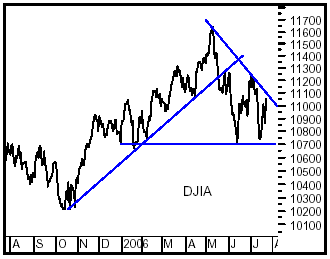
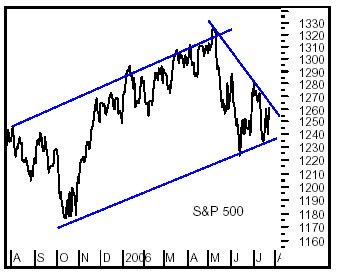
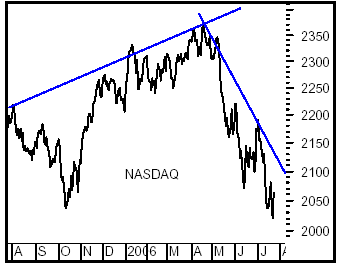
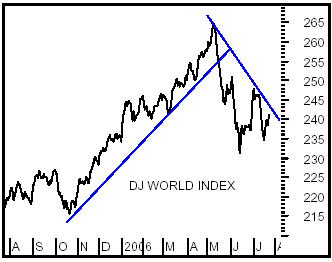
Even with the short-term upside volatility of the past week, which included a triple-digit rally of 212 points by the Dow a week ago today, and another of 182 points on Monday, the charts of the stock market are not encouraging.
For instance, as shown in the nearby mini-charts the major indexes have not even broken above the short-term trend-line resistance drawn through the peaks of the previous rally attempts that have taken place since the May top.
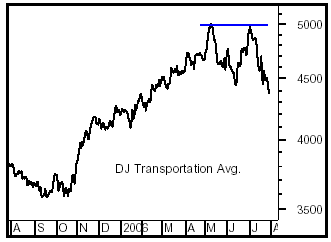
REVERSAL OF TRANSPORTS.
The DJ Transportation Average, one of the strongest areas since the October low, and which often leads the Dow Industrial Average, had fully recovered from the market’s May sell-off a couple of weeks ago, providing hope that the rest of the market would follow. However, upon reaching its previous peak, the Transports returned to the downside, leaving a bearish double-top in place, and have now made a new correction low.
It’s Global.
The Dow and S&P are 5% below the May peak. The DJ World Index is 8.8% below that peak.
Positioning. We took our long-side profits in May, and our first batch of downside positions. We took the profits from most of those downside positions in June, when it looked like the oversold rally might last a bit longer than we expected. And we recently began positioning for the downside again.
STS received its official exit signal May 12. The market is now in its unfavorable season until next fall. Its timely entry was October 24. We will continue to use downside positioning for part of the unfavorable season in the Aggressive Seasonal Timing portfolio, while the normal STS portfolio is earning interest on cash for now.
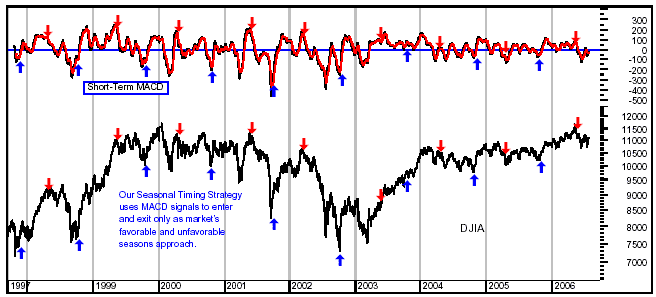
To what degree STS will out-perform the market this year will depend on how much lower the market is when STS re-enters in the fall.
However, we opted not to follow the rules of our STS Strategy this year, due to the risk that the serious market correction we expect this year might begin early. So we took our STS profits early, on Feb. 6. Those who chose to stay with the rules of the strategy exited on the official STS sell signal of May 12. The S&P 500 was 2.3% higher than at our early exit, and we made less than 1% from interest on cash in those three months. However, whether the extra 1.5% available by staying in was worth the risk is debatable.
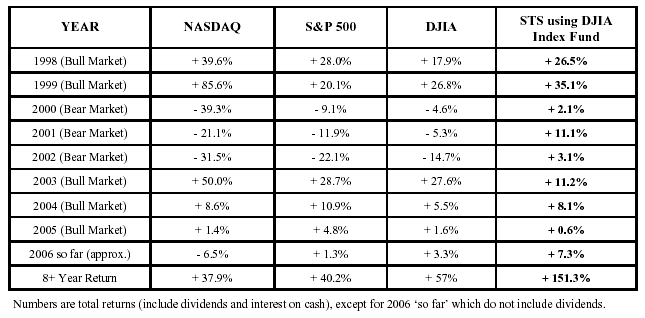
By exiting early we under-performed the simplicity of the mechanical STS strategy. In spite of the negatives that developed after January, the market held up to the end of its favorable season as defined by our STS strategy. In fact, the official STS exit signal took place just two days after the Dow hit its peak of 11,642 on May 10. The following table shows the 8-year performance of the STS strategy, if followed by the rules, entering and exiting 100% on the official MACD signals, and using the DJIA Index as the holding on each entry. Although under- performing the market in 2003, it was still up for the year, and unlike the market had no down years (since most of the damage in market corrections, even in bear markets, takes place in the market’s unfavorable seasons).
The consensus of the 35 intermediate-term technical indicators we utilize deteriorated to a sell signal on February 3. As a result we took our profits on most holdings, but did not take downside positioning, waiting for it to become more clear whether our sell signal was correct or not.
Meanwhile, we had been making double-digit profits away from the general market, in gold, the energy sector and Japanese market, while awaiting the time when we could take downside positions on the U.S. market. With the renewed sell signals on key indicators, and the end of the market’s favorable season, as indicated by the exit signal triggered on May 12 by our Seasonal Timing Strategy, we had the downside confirmation we had been waiting for, and moved significantly to downside positioning on May 16. The S&P 500 subsequently broke below its important intermediate-term 20-week m.a. into the usually bearish lower half of Bollinger Bands.
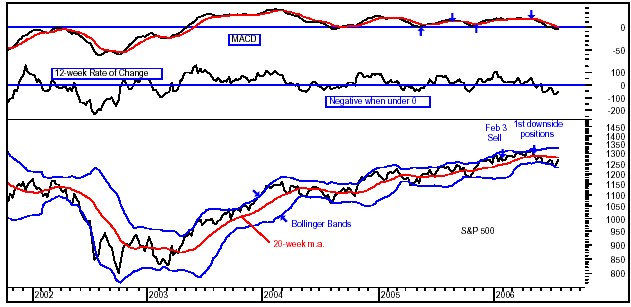
The seriously negative fundamentals; rising inflation, rising interest rates, toppling real estate sector, record consumer debt, record Federal budget deficits, unfavorable seasonality, international turmoil, etc., support the sell signal on the technical indicators, and our expectations for the sell signal to produce an important low in Oct./Nov. But as we have been saying, it will not be a straight line down. There will be short-term rallies.
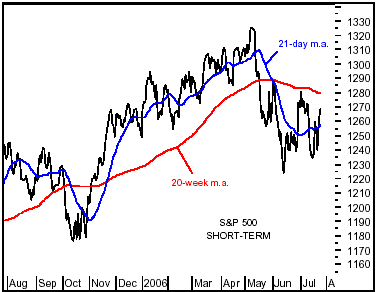
In the small chart below we zoom in for a closer look at those short-term rallies. After breaking below its 20-week m.a. in early May the S&P became short-term oversold beneath its 21- day m.a., (the blue line in the chart below). As we told you to expect, it then rallied back up to the 21-day m.a., which was coincident with the 20-week m.a., was unable to break through either m.a., and headed south again.
When it once again became short-term oversold beneath its 21-day m.a., and began to rally again, we opted to temporarily take our profits from the downside positions, expecting the next oversold rally could morph into somewhat of a summer rally. And indeed that next rally broke through the short-term 21-day m.a, and did not end until it reached the more formidable resistance at the 20- week m.a. (the red line), where it did fail. In its current short-term rally attempt it is again approaching the 20-week m.a., which we expect will again turn the rally back. The S&P 500’s 20-week m.a. is currently at 1,279.
NASDAQ.
The consensus of our indicators on the Nasdaq also remain on the sell signal of February 3. The Nasdaq led the market down in the 2000-2002 bear market, ultimately declining from its 2000 high of 5,132 to its 2002 low of 1,108, a loss of 78% of its value. It then led the market up in the subsequent 2002-2006 bull market, rising from its 2002 low of 1,108 to its peak this year of 2,370, a gain of 114% (which was still 54% below its 2000 peak). It now seems to be leading the rest of the market down again, having lost 13% since its April peak.
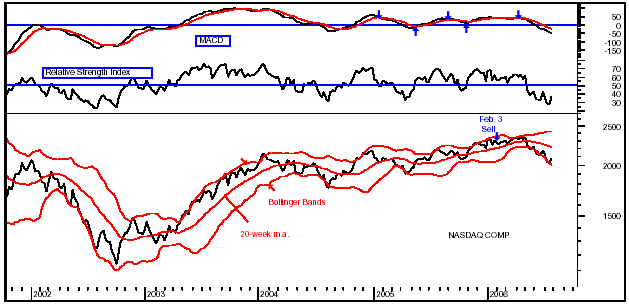
The Nasdaq broke below its important 20-week moving average into the bearish lower half of Bollinger Bands. And unlike the S&P 500, neither of the recent two short-term oversold rallies managed to bring the Nasdaq even close to testing the overhead resistance at its 20-week m.a., as it continues to slide down the lower limit of Bollinger Bands. In the above chart a break below the 20-week m.a. may not seem as important as we are saying it is, since it also happened in 2004 and again in 2005, and the subsequent declines were minor. However, the market of the last two years has been very unusual. It has not had even a normal intermediate-term correction since the bull market began in 2002, only rolling over into an unusual flat trading range at the end of 2003. The very low interest rate environment and easy money, which allowed the real estate bubble to continue, contributed immensely to the resilience in consumer spending and the economy. However, with the cumulative effect of the Fed’s 17 small rate hikes, that situation has changed.
In the chart below we zoom in to get a clearer picture of the Nasdaq’s action since it topped out.
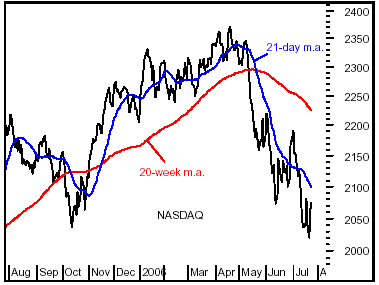
It has made only feeble attempts to rally, moving back up to its short-term 21-day m.a. once, and above it once, as did the Dow and S&P 500. However, the Nasdaq has not come close to even testing the important 20-week m.a.
One of the minor concerns we have had is that the current short-term rally attempt by the Dow and S&P 500 began before they made a lower short-term low, which while they are in a pattern of lower highs, also leaves a higher low in place, sometimes a positive.
That is not so with the Nasdaq, which continues to make lower lows as well as lower highs. In the process, it has already given back all of its favorable season gains since last October.
Gold Bullion.
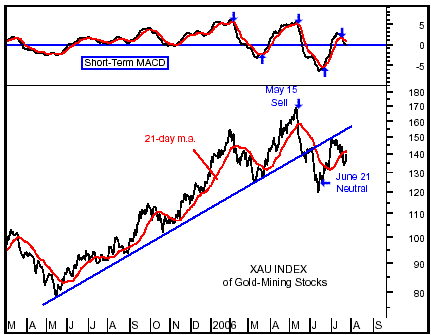
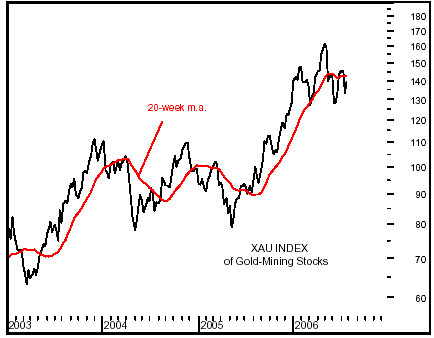
We remain neutral on the gold sector. The May 15 sell signal was triggered just two days after gold reached its peak of $725, and three days after the XAU Index of Mining Stocks peaked at $168.62.
Its subsequent decline removed the extreme overbought condition above its 200-day m.a., and had gold short-term oversold beneath its 21-day m.a. (not shown). We took our profits on our short-sales of gold stocks on June 21, having moved to neutral from the sell signal, as short-term MACD also triggered a short-term buy signal off the oversold condition. That short-term rally has now run out of steam, with gold reversed back to the downside, short-term MACD now on a short-term sell signal.
As we were pointing out as gold climbed in its parabolic rally, even in its bull markets gold has a history of returning to its 200-day m.a., at least once a year, and has not done so since last August.
Meanwhile, the XAU Index of Mining Stocks, which frequently leads the bullion in both directions, was even more negative in its sell-off from its May peak. The XAU gave up all of its gains for the year, getting back to its level of last November. At that point it was also short-term oversold beneath its 21-day m.a., shown in middle chart. We took our profits from the short-sales on expectation of a shortterm rally off that oversold condition.
The subsequent rally carried the XAU back up to the previous trendline support, which we said was likely to now be overhead resistance. At that point it was again oversold above the short-term 21-day m.a. And sure enough it has returned to the downside.
It is now attempting to rally again, and from a higher low, which has out attention. However, that bounce this week is coming after a big one-week decline of 8% last week, so may be just a brief ‘dead-cat bounce’. Meanwhile, on the intermediate-term chart (the bottom chart), the XAU remains broken below its important 20-week m.a., and is potentially forming a head and shoulders top. Putting all the factors together, we remain neutral on gold.
[Portfolios Reserved for Subscribers ]
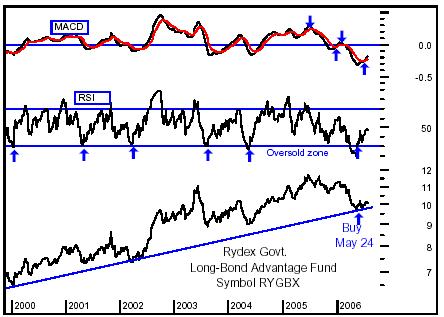
U.S. Treasury Bonds. Our indicators remain on the buy signal of May 24 for bonds, and we are 25% invested in the Rydex Government Long-Bond Advantage Fund.
The buy signal is supported by investor sentiment, which is universally bearish for bonds, as in how could bonds rally in a meaningful way with the Fed still raising short-term interest rates?
We suspect bonds are looking ahead (as all markets do), beginning to anticipate that the Fed is going too far with its rate hikes, will slow the economy too much, perhaps even into recession, as it often does when in ratehiking mode, and will have to reverse itself to begin cutting rates by year end.
SUMMING UP: We remain on a sell signal for the stock market, expecting the correction to continue to a meaningful low in the October/November time-frame. As almost perpetually bullish Sam Stovall, chief investment strategist at Standard & Poor’s said in his latest client wire, “History shows that the market tends to slip into neutral, if not reverse, during the July through September period.” To paraphrase Stovall’s additional comments, this time around the ‘wall of worry’ the market tends to climb is becoming too high to be used as stepping stones.
We are 40% in our 2nd batch of downside positions on the stock market this year, 25% in bonds, 35% in cash, but planning to take on more short-sales and downside positions once the current short-term rally begins to top out.
Once the correction reaches its low, probably in the fall, we expect a substantial new up-leg, since from the low in the 2nd year of every Presidential Administration since at least 1918, the market has launched into such a great rally that even the stodgy Dow averaged a gain of 50% to its high the following year.
For more information about Sy Harding and the Street Smart Report, click here.


