


By Arthur B. Hill - Fri 28-Jul-06 1:15 PM EDT
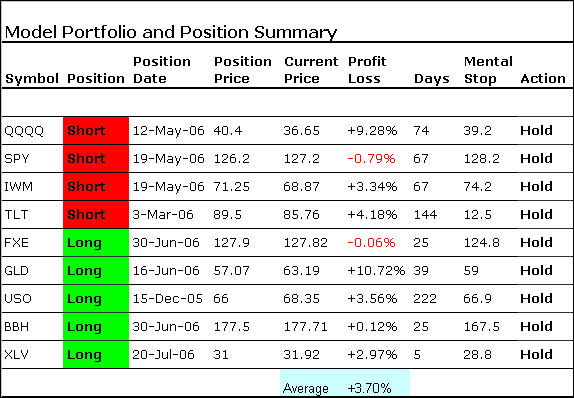
I remain bearish on the stock market overall. The defensive sectors and groups arestrong, but the there is weakness in the economically sensitive sectors. The modelportfolio reflects this stance with a bearish position in QQQQ since mid May and recentbullish position in the HealthCare sector this month.
Here are two of the headlines from today.
- SmartMoney: “Stocks Rise on GDP Fall”
- TheStreet.com: “Slow Growth Sparks Stocks”
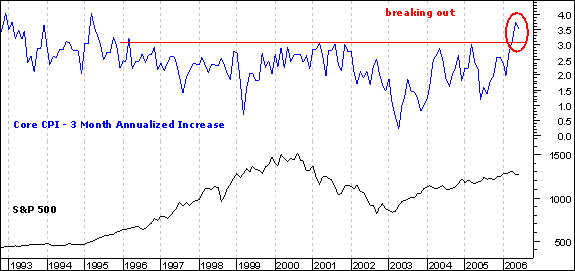
The other half of today’s headlines focused on a sharp rise in inflation via theConsumer Price Index. I am not sure where this headline or statistic came from becausecore CPI was reported on 19-July. The Fed allegedly watches this gauge closely and coreCPI (less food and energy) is growing at its fastest rate since 1994. Inflationarypressures are running at 12 year highs and this is not positive.
Putting two and two together, slowing growth and rising inflation equal stagflation.This is not a good recipe for stocks. Slowing growth means falling sales. UPS was thelatest to disappoint and the shares were clubbed for a 10.3% loss. Rising inflation meanshigher interest rates and higher costs. Dow Chemical blamed higher energy costs for itsmiss and the shares lost over 10% on the day. Stagflation means decreasing profits andthis will weigh on stocks.
Don’t take my word of the economy’s word for it though. Ask the charts! TheNasdaq, Consumer Discretionary sector and Transportation group are leading the way lower.These three are most sensitive to the economy and slowing growth would not be welcome. Inaddition, we are seeing relative strength from the Consumer Staples, Utilities andHealthCare sectors. These three sectors are defensive and this is where money moves whentimes are tough.
As of this writing, stocks are up sharply on Friday (12:30 ET). The ability to shrugoff bad news is certainly positive and some sort of summer rally is underway. I do notthink this summer rally will turn out like the blast in August 2004 though. For one, QQQQ(tech) is lagging and we have yet to see even a break above the May trendline. Inaddition, and as noted below, breadth remains in bear mode and there is just not enoughevidence to warrant a trend change yet.
***A Battle For Support***
After a sharp decline in May and June, stocks firmed over the last seven weeks and atrading range is taking shape. This is quite normal. The May-June decline created anoversold situation and the market had to work off this condition with a bounce or aconsolidation. With a bounce in late June and this past week, the market is doing a littleof both (bouncing and consolidating) to work off oversold conditions.
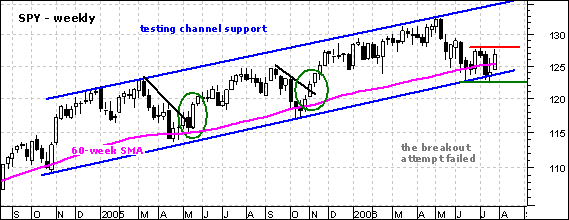
Using the S&P 500 ETF (SPY) as the proxy for the stock market, we can see a risingprice channel extending up from the Oct-04 lows. There were two pullbacks during thisadvance (green ovals) and both lasted 9-10 weeks. Also notice that the 60-week movingaverage and lower channel trendline marked support. SPY is currently consolidating around125 and the resolution of this consolidation holds the key to the next move. A move below122.5 would signal a continuation of the May-June decline and project further weakness toaround 117. A break above 128 would keep the rising price channel alive and we could evensee a move back to the upper trendline. It depends on the volume and breadth behind anybreakout. Let’s see the evidence turn bullish before going out on a limb.
***Breadth Remains Bearish***
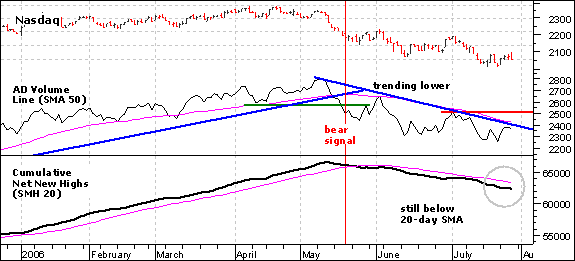
For the Nasdaq, the AD Volume Line triggered a bearish signal in mid May and remains ona bear signal. The decline has slowed over the last six weeks, but we have yet to see anupturn and bull signal. The AD Volume Line would have to break the blue trendline, 50-dayEMA and early July high to turn bullish. The Cumulative Net New Highs Line remains belowits 20-day SMA as new lows continue to outpace new highs (thanks to Networking, Semis andInternet stocks).
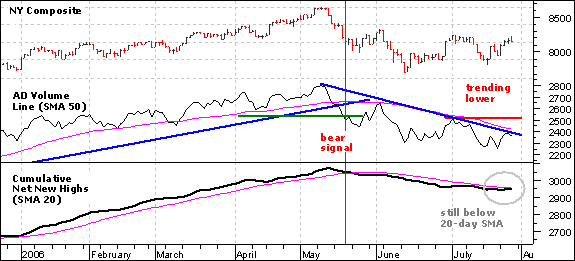
NYSE breadth is not as weak as Nasdaq breadth, but it is still bearish overall. The ADVolume Line triggered a bearish signal in mid May and remains on a bear signal. Thedecline slowed the last six weeks, but the AD Volume Line still hit a new low in July andremains well short of a bull signal. The Cumulative Net New Highs Line remains below its20-day SMA.
***Dow Transports Break Down***
Because it is one of the most economically sensitive groups, I always pay closeattention to the Dow Transports. The corresponding ETF is the Transport iShares (IYT), butI am going to use the Dow Transports for analysis purposes today. Transportation is thebackbone of the economy. People and goods move when the economy is strong and this meansmore business for transport related companies (shipping and traveling). Energy costs havebeen rising the last few years and oil remains at relatively high levels. However, thisdid not deter the Dow Transports as it advanced over 65% from January 2004 to May 2006.Rails, truckers, airlines and freight companies all shared in this advance. Strength inthe Dow Transports told us that the economy was strong and high oil prices were not aconcern.
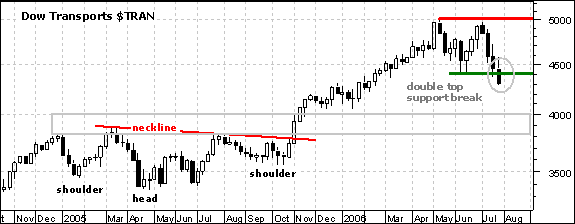
Things are a changing. Energy prices remain high, but now the economy looks vulnerableand the Dow Transports broke double top support. This is a concern. The double top is abearish reversal pattern that requires confirmation with a break below the intermittentlow. The Dow Transports formed two peaks at 5000 and a low at 4400. The Average brokesupport this week to confirm the pattern and the downside target is to around 3800-3900.This support area is confirmed by broken resistance and the Dec-Jan lows (gray rectangle).
***Half Of A Dow Theory Sell Signal***
The Dow Theory is built on the writings of Charles Dow, William Hamilton and RobertRhea. Dow did not propose an exact theory, but Hamilton and Rhea derived the principles ofDow Theory from Dow’s writings in the Wall Street Journal. The basic premise is thata sell signal occurs when both the Dow Industrials and Dow Transports move below theirprior reaction lows. A buy signal occurs when BOTH move above their prior reaction highs.A non-confirmation occurs when only one Average moves to a new high or low and the otherfails to follow suit.
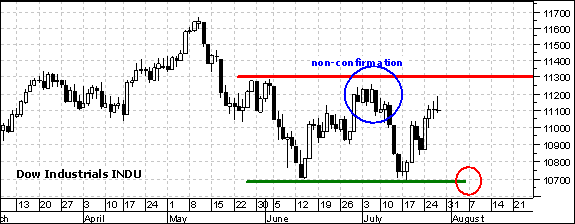
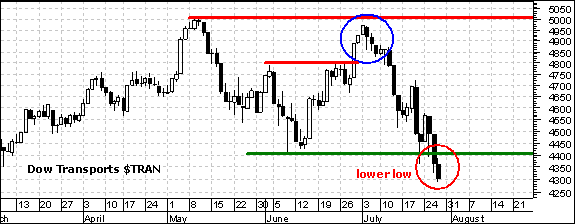
I am showing the two charts together for easy comparison. First, we have anon-confirmation when the Dow Transports moved above its June high and the Dow Industrialsfailed to break its corresponding higher (blue circles). This signaled that the two were“out of sync” and served as a warning of weakness. The Dow Transports went onand broken below its June low (red circle), but the Dow Industrials has yet to follow suitand confirm. A move below the June-July lows in the Dow Industrials would produce a DowTheory sell signal. These signals are not perfect, but their historical track record overthe last 50 years is impressive.
***Changing of the Guard***
Small-caps and the Russell 2000 led the advance from Mar-03 until May-06. It was atruly impressive run as the Russell 2000 iShares (IWM) moved to new all time highs thisyear. IWM fell with the rest of the market in May-June and this was to be expected.However, IWM is refusing to bounce in July and small-caps are starting to lag large-caps.
It is bullish when small-caps lead and bearish when they lag. These stocks have higherbetas, higher growth prospects and higher volatility. In a nutshell, these stocks areriskier. In a broad market advance, these stocks should lead the way higher. Something iswrong with the overall market when these stocks lag It shows a low appetite for risk and apreference for defense over offense.
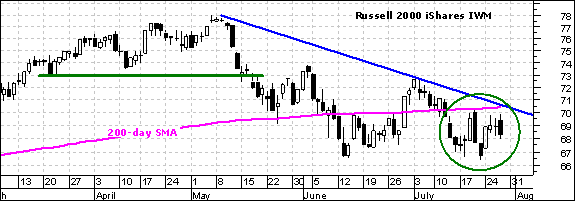
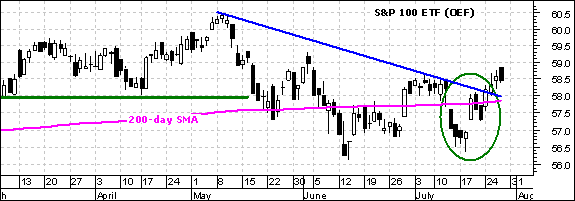
The two charts shows the Russell 2000 iShares (IWM) and the S&P 100 ETF (OEF). TheS&P 100 ETF (OEF) surged over the last two weeks and moved back above its 200-daymoving average. The Russell 2000 iShares (IWM) has been stuck in a range. The stockremains below last week’s high and the 200-day moving average.
***Techs Stocks Lagging Too***
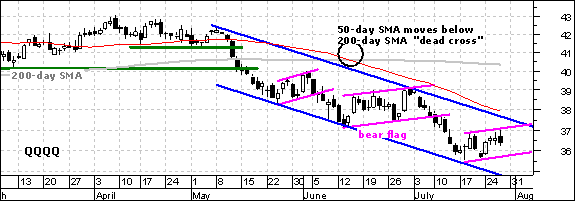
Using the Nasdaq 100 ETF (QQQQ) as the proxy for tech stocks, we can see that this ETFremains in a clear downtrend defined by the falling price channel (blue trendlines). TheETF firmed over the last two weeks, but this looks like another rising flag (the third inthree months – magenta trendlines). Rising flags are bearish continuation patterns. Amove below the lower trendline would signal a continuation of the bigger downtrend. Eventhough I find QQQQ oversold currently and ripe for a bounce, I see no evidence of a baseor trend change and my stance remains bearish.
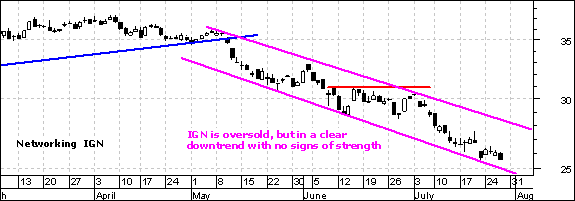
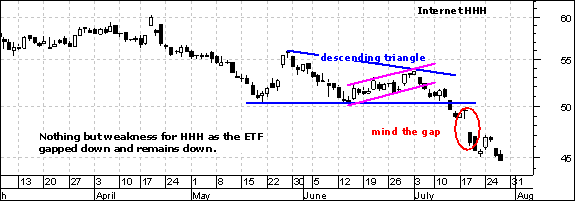
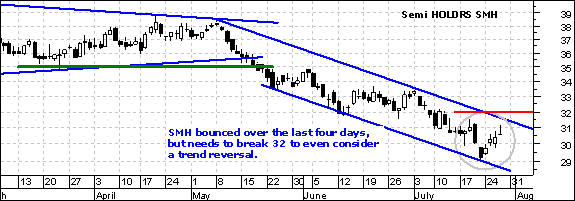
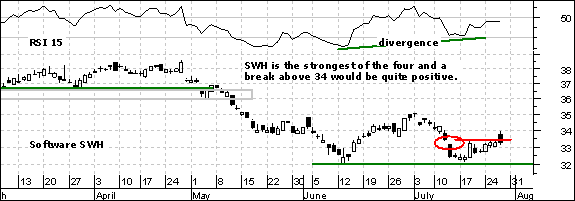
QQQQ can be broken down into five groups or ETFs: Software (SWH), Semis (SMH),Networking (IGN), Internet (HHH) and Biotech (BBH). Four of these groups are part of theTechnology sector. The Biotech group is part of the HealthCare sector. The four techgroups drive QQQQ and the Nasdaq. QQQQ rises when all four are bullish, falls when all forare bearish and trades flat when they are mixed. All four are bearish right now. The Semis(SMH) and Software (SWH) show some firming, but Networking (IGN) and Internet (HHH) aredefinitely bearish. Until three of the four get on the bullish tract, a trading range isthe best the bulls can hope for.
***Does the Fed Really Matter***
Last week I argued that a pause in interest rate hikes by the Fed was likely to beshort-term bullish and long-term bearish. Moreover, a change in Fed policy that favoredlower interest rates would likely signal economic weakness and this would be bearish forthe stock market overall.
In his weekly column, John Hussman of HussmanFunds.com argues that the Fed is largelyirrelevant. Here is the opening paragraph:
It continues to astonish me how much power investors appear to ascribe tothe Federal Reserve. The institution can do nothing but purchase debt (mainly U.S.Treasuries) and pay for it by creating bank reserves, or sell debt and receive payment byreducing bank reserves. When you realize that the total volume of bank lending hasvirtually no link at all to bank reserves (since the majority of monetary aggregates otherthan checking accounts have had zero reserve requirements since the early 1990's), andthat foreign purchases of U.S. Treasuries have swamped Fed activity in Treasuriesthree-to-six times over in recent years, this whole focus on every word, syllable, andinflection from the Federal Reserve is just preposterous.
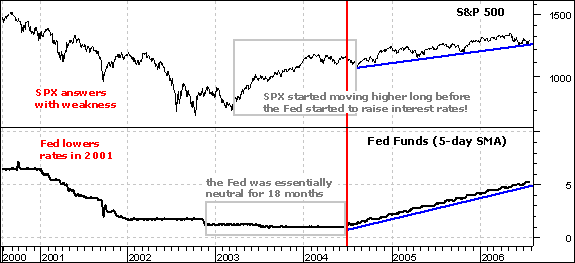
A look at the chart for Fed Funds shows that the Fed lowered rates throughout 2001 andthe S&P 500 kept right on falling. The Fed funds rate was essentially flat from Nov-03to Jun-04. The S&P 500 bottomed in Mar-03 and advanced over 35% by early 2004. The Fedthen started raising rates in June 2004. Despite consistent interest rate increases, theS&P 500 keeps right on trucking. Lower rates are not the answer to the stock marketwoes.
***Life In HealthCare***
While techs stocks remain in the doldrums, HealthCare sprang to life last week. TheHealthCare SPDR (XLV) and Pharma HOLDRS (PPH) both surged above resistance and have becomemarket leaders.
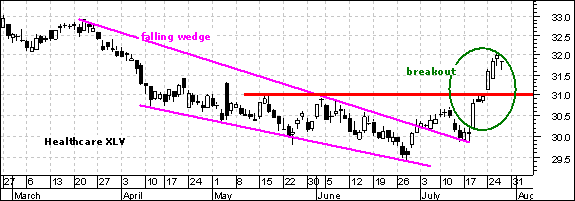
I highlighted the HealthCare SPDR (XLV) over the last few weeks and added it to theModel Portfolio (position summary) last Thursday. The ETF broke above the upper trendlineof a falling wedge in early July and surged above its June high this week. The breakout isstrong and bullish. The stock is getting short-term overbought and could be ripe for apullback or consolidation over the next week or two. However, I think this breakout isvalid and points to higher prices over the next few months.
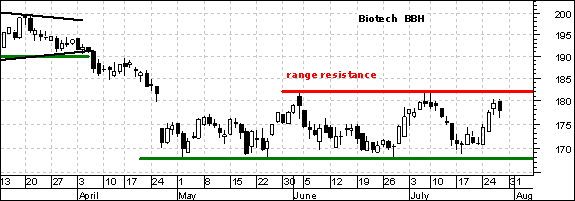
The Biotech HOLDRS (BBH) represents a more volatile part of the HealthCare sector. Iadded BBH to the Model Portfolio (position summary) on 30-June and the stock remains rangebound. The stock held up better than the Nasdaq over the last three months and formedsupport at 168. There was another surge to resistance this week and a breakout would bebullish. Failure to breakout and a move below key support at 168 would turn this chartbearish and I would exit my position.
***Bond Breakout In the Works***
The latest economic news on Wall Street shows slowing GDP and rising inflation. Thisspells stagflation and bonds surged on the news. It is really a double-edged sword forbonds. Rising inflation puts upward pressure on rates, while slowing growth puts downwardpressure on rates. One must guess which one is the lesser of two evils. Or, which one theFed thinks is the lesser of two evils. My guess is the Fed would rather inflate than die.
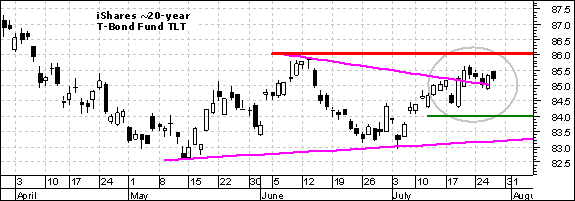
The iShares ~20-year T-Bond Fund (TLT) has been working its way higher the whole monthand is on the verge of breaking resistance at 86. The bond ETF broke the triangletrendline and a move above the June high would be considered bullish with the next targetaround 88. TLT is currently trading at 85.8 and I will wait to see a close above 86 beforechanging my position.
***Gold Correction Ends***
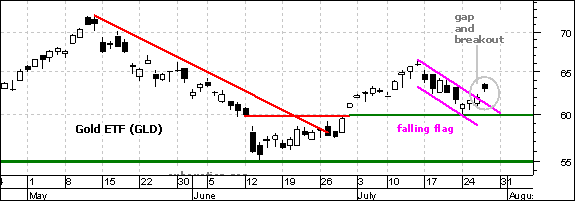
I marked support for gold at 60 on 14-July and this level held like a charm. GLD formeda falling flag over the last two weeks and broke above the upper trendline with a gap up.This signals a continuation of the Jun-Jul advance and forecast a move towards the Mayhigh. I still think gold remains in a long-term bull market.
Have a good weekend –Arthur Hill
Next Report: Friday 4-August-06
ETF Investment Outlook is a weekly newsletter that is usually published everyFriday. Changes to the position table or model portfolio are sometimes necessary betweenpublications and special portfolio alerts will be issued by email and posted to thewebsite when necessary.
Disclaimer: Arthur Hill is not a registered investment advisor. The analysispresented is not a solicitation to buy, avoid, sell or sell short any security. Anyoneusing this analysis does so at his or her own risk. Arthur Hill andETFInvestmentOutlook.com assume no liability for the use of this analysis. There is noguarantee that the facts are accurate or that the analysis presented will be correct. Pastperformance does not guarantee future performance. Arthur Hill may have positions in thesecurities analyzed and these may have been taken before or after the analysis waspresent.


