



Anniversary Recollections: Thirty-one years ago this July, I was living one block away from the Hollywood Bowl and pursuing a career in show business. Mind you, I had recently graduated from Harvard College and Boston University Law School and passed my bar exam in Massachusetts. But my love of music drew me into the world of show business and after four years of performing in Manhattan cabarets and nightclubs, I concluded that Hollywood was beckoning. It was indeed a strange journey because my financial career was spawned among the bookshelves of the Hollywood library. After making my first investment in the stock market in December 1968 in a mutual fund that was up over 300% so far that year, and after seeing that fund decline almost 20 percent within a few months of my purchase, I made up my mind I would look more closely into the almost mystical ups and downs of the stock market. Within a very short period of time after reading the J. M. Hurst book entitled The Profit Magic of Stock Transaction Timing, my passion for the stock market began and slowly turned into an obsession.
Cycles had guided me in predicting a very major market bottom for the week of December 9th-December 13th, 1974. That prediction was made on Los Angeles television station KWHY and it ended up being a virtually perfect call as the Dow Jones Industrial Average registered its lowest low of the prior 12 years and a low which has never been approached since then on exactly December 9th, 1974. This newsletter began publication seven months later in July 1975. Towards the end of the decade between 1970-1980, we had uncovered some very long term cyclical patterns that led us to believe that within one-two years one of the major bull markets in our financial history would begin. That conviction came about because we had spotted a cycle from the long-term data provided by the Foundation for the Study of Cycles that had seen three prior resolutions. We called it the longest cycle we had discovered in looking over the long-term history of our stock market. It was a 60 year cycle with major bottoms within 1-2 years of 1800, 1860, 1920, and 1980. Through happenstance and a little research, we now contend we have spotted an even longer cycle. The 60 year cycle that bottomed within a year or two of 1980 has more than fulfilled its promise. It has driven stock prices to valuation levels that had never before been seen and, for an encore, held prices up at these amazingly overvalued levels for almost a decade. There is an even longer apparent cycle than the 60 year cycle, however, and it is that cycle we will discuss in our section on THE CYCLES.
—THE CYCLES—
In our newsletter dated August 5th, 2005, we discussed a 25 year cycle in the stock market with ideal resolutions in the years 1907, 1932, 1957, 1982, and 2007. Here is part of what we said:
... every resolution of the 25 Year cycle has been an exact resolution and has marked a low point which the market has never since penetrated. More specifically, the lows of 1907, 1932, 1957, and 1982 were exact bottoms and the market has never again moved below those levels. That makes the prospects for the year 2007 very interesting. First of all, it argues that there will be no important bottom in the year 2006 unless it occurs very late in the year and it joins forces with a very early 2007 resolution of the 25 Year cycle bottom. Remember that in the past, if the two cycles had different resolutions, it was the 25 year cycle that ruled. The larger question that looms, of course, is whether the 25 year cycle will be as important a bottom this time around as it has been in the past. It is our contention that if that is to occur, that cycle resolution will be preceded by a devastating decline and a long period of investor bearishness.
Recently we saw a 25 year cycle discussed in negative terms offering the opinion there was no such cycle. We responded with our own evidence of such a cycle and this is one of the responses that our comment elicited:
Hi Peter I always admire your cycle work! Great research. Some time ago I mentioned about the 75 yr cycle (3x25) which in the past has always seen MEGA Lows (1932, 1857, 1782...). My opinion is if there is a 75 yr cycle the market should crash in 2007 - or if 2007 will be a higher Low than 2002 it would be “only” a simple 25 yr cycle Low. Another possibility is that the 75 yr cycle is inverting this time and we won’t see these Highs for many many years anymore. What is your opinion about that 75 yr cycle ??
It was written by a gentleman named Peter Behringer and we must admit we were fascinated by his observations. The 25 Year cycle can be easily documented throughout the data of the past 100 years. We had never even thought of attempting to go back further because of the paucity of the data prior to the mid 1800s. We could see, however, from the data from The Foundation for the Study of Cycles that two of the most important market bottoms of the past 200 years occurred in 1932 and 1857. Most people are aware of the 1932 bottom and its importance in market history, but few are aware of the almost equal importance of the 1857 bottom. The data from The Foundation for the Study of Cycles presents monthly average prices for the American securities markets back to 1789. Those monthly averages are determined by taking the average daily price throughout the month. The price low registered for the month of October 1857 was the lowest price since May 1843 and, in fact, was lower than all the monthly averages between June 1814 and December 1841. Perhaps more importantly for the purpose of this study, prices never again returned to the 1857 levels.
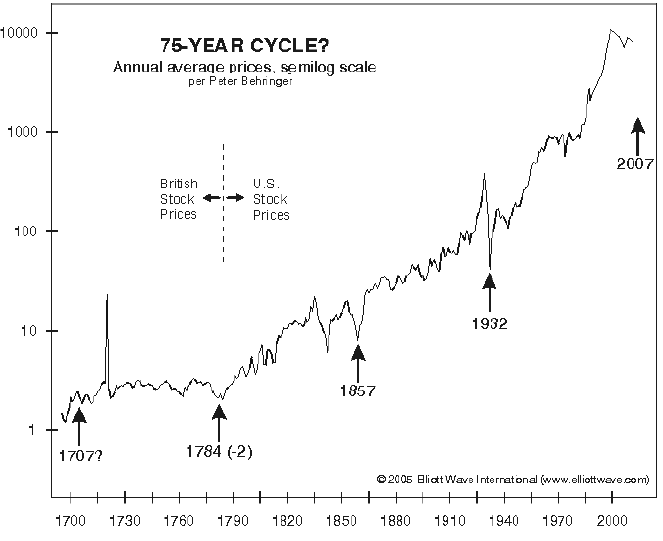
So now we had evidence of at least two very important cycle bottoms exactly 75 years apart. Of course, there was no statistical significance up to that point because one would need at least three cycle bottoms within a pattern to show that the pattern had repeated at least once. We needed to determine if there was any evidence of a bottom in security prices around the year 1782. Our buddy, Bob Prechter, the editor of the Elliott Wave Theorist came to mind immediately. Bob had researched security prices in Great Britain prior to the start of the record of American security prices in 1789. It just so happened that Bob had published a long-term chart in his December 10th, 2004 newsletter which went back to the early 1700s. The title on that chart read: BULL MARKET IN U.S. STOCKS FROM 1784.
Remember, we were looking for evidence of a bottom in security prices around the year 1782. Without looking any further, the evidence was staring at us in the title to the chart. We could easily live with an error of around two years in a cycle whose length was 75 years long. We should emphasize also that the scarcity of data in those days could itself be the cause of a onetwo year error in identifying a major market bottom. Having gone back that far, it just so happened that the Prechter chart went back to the turn-of-the-century carrying into the 1700s. The cycle bottom prior to the ideal resolution that was due around 1782 would have occurred around 1707. It does not take too much imagination to see that security prices began a rally around 1707 that quickly led to the South Sea Bubble just over a decade later. The huge break in that bubble did not bring prices below the 1707 lows but there was little to no progress in British securities prices over the next 60 years until the next 75 year cycle bottomed around 1782. The front page chart, courtesy of Robert Prechter, clearly shows the general delineation of these 75 years cycles.
It should be clear from the chart that, with the probable exception of 1707, the 75 year cycle bottoms in the past have taken stocks to multi decade lows. One can only imagine the potential market vulnerability if the year 2007 is scheduled to see a multi decade low. Is it even in the realm of possibility that the market could return to prices seen in the 1980s? All we know is that the pattern has been quite consistent for 300 years. With only four previous resolutions, we cannot label it as statistically significant but we indeed can prepare ourselves for what it might be telling us.
Let’s not ignore the other possibility mentioned above in Peter Behringer’s response to our post. He mentions the possibility of a cycle inversion. Although we dislike the use of the concept of inverted cycles, we have often referred to the George Lindsay theory that, in effect, states that “bottom-to-bottom equals bottom-to-top.” With market valuations arguably remaining in the stratosphere for almost a decade now, it would not be difficult to visualize that a very important market top will be reached in the year 2007 that might last for years and years to come. In that way, the year 2007 would be a top the same distance from the 1932 bottom as the 1932 bottom was from the 1857 bottom, and on a longer basis, the year 2007 would be a top the same distance from the 1857 bottom as the 1857 bottom was from the 1707 bottom.
We realize, in effect, that the above analysis might appear to be of little use because it is telling us that 2007 could either prove to be a top or a bottom. What is most important to remember, however, is the relative importance of that potential top or bottom. If it turns out to be a bottom of great importance, the prior history of the 75 year cycle prepares us for the possibility of a devastating decline. If, on the other hand, it turns out to be a top of great importance we should know by late 2007 that the market faces several more years of sideways to down market behavior. The bottom line is that 2007 is scheduled to be a year of paramount importance.
—TECHNICAL INDICATORS—
[Reserved for Subscribers]
—MARKET PROJECTIONS—
[Reserved for Subscribers]
—MUTUAL FUNDS—
Rydex switchers bought the Rydex Tempest Fund (now called the Rydex Inverse Dynamic S&P 500 Fund) at the July 18th morning price of 41.51 and sold the fund on the close of July 27th at 39.64 for a loss of 4.5% on the trade. They have since repurchased the same fund at 38.74 on August 2nd. Fidelity Select switchers bought Fidelity select Gold fund on July 20th at the 10:00 a.m. Eastern time price of 33.73. We have two different specific model portfolios-one for Fidelity Select switchers and one for Rydex Group switchers. How you distribute your own portfolio is up to you as an individual.
“Stockmarket Cycles” is published the first Friday of the month by Peter G. Eliades. Information is gathered as carefully as possible, but no guarantee can be made as to the accuracy of text or charts. The analysis of stock market cycles is more an art than a science. No guarantee can be made that recommendations will be profitable or will not result in losses. This subscription will not be reassigned without the consent of the subscriber. All information contained herein and given on the telephone update may not be reproduced or rebroadcast in any form whatsoever without the written consent of Peter G. Eliades.
1 year (12 issues) letters only $252.00 6 months (6 issues) with daily telephone update $261.00
1 year (12 issues) with daily telephone update $480.00 2 issue trial with daily telephone update $98.00
Next Publication Date: September 1, 2006


