



Don’t Be Spooked By October — Volatility Breeds Opportunity
Tame Inflation & Accommodative Fed Can Fan Seasonal Flames
By Jeffrey A. Hirsch
www.stocktradersalmanac.com
After abating somewhat over the last two months volatility has perked up again here in ornery old October. But this is to be expected. Two issues ago we presented a one-year seasonal graph that showed a steady increase in volatility from the end of July through the end of October. We were not surprised to see increased volatility during the worst four months of the year.
Stocks have been on a tear since the August low. The Dow was up 10.3% over the last two months at its recent all-time high. The blue-chip behemoth’s stellar performance has lagged the S&P 500, up 11.3%, the Russell 2000, up 12.5%, and the NASDAQ’s amazing 14.7% run. It’s no wonder that stocks have consolidated this week.
Nostalgia for Black Monday leading up to the 20th anniversary of 1987 Crash this Friday and a general case of “Octoberphobia” are contributing to the nervousness on The Street. Some disappointing earnings and economic readings have given traders pause. The housing recession continues unrelentingly and the credit markets are still on thin ice.
However, these problems are well known and are being dealt with unabashedly by the Fed, the Treasury Department and the big boys on Wall Street. The mysterious “plunge protection team” is no longer a surreptitious affair. Three massive U.S. banks in conjunction with the Treasury have publicly declared their intention to bail out the credit crunch—and make money doing it. Tame inflation numbers leave the door wide open for Bernanke and his crew to accommodate any further slowing of growth or fallout from the housing/credit debacle.
Pulse of the Market
Though the market has pulled back slightly this week the Dow remains safely above its 50-day moving average (black line) showing resilience in the face of myriad obstacles. Downward action has pushed the MACD Buy below its buy threshold but, the signal has been given and momentum remains positive.
The market’s five-week tear had begun to wane last week so some retrenchment is to be expected. There have not been any Down Friday/Down Mondays since the week before the August plunge . Breadth has been positive the last five weeks though some improvement there would be welcome. New highs have been building and new lows receding .
Sentiment has become increasingly positive with put/call below 0.60 7 for the first time since early July. Investors Intelligence bullish and bearish percent have also gotten quite frothy with the bulls at 60.2% and the bears down to 21.5%. This is a big reversal from when they nearly touched at about 40% each at the low in August. However, as we’ve seen in the past these contrary indicators can run hot for months, especially November-January.
Sweet November Gains
Ah November, Wall Street’s favorite month. As the days shorten the yearend spirit kicks in with visions of dressed turkeys, pumpkin pie and Black Friday. Not Black Monday, the infamous worst single day on The Street, but the Friday after Thanksgiving when retailers expect to go into the black as holiday shopping gets into gear.
November ushers in the best three-month span and the Best Six Months and sports some of the best monthly market gains over all time periods. Since 1950 it ranks number one on the S&P 500 and third on the Dow with 1.8% and 1.7% gains respectively.
Since 1971, when NASDAQ started, it garners a number-two ranking and a 2.2% gain for the tech-heavy composite. Since 1979 when our Russell index data begins, November is the best month for the big caps and second for NASDAQ and the small cap Russell 2000 with average gains of 3.0% and 2.6% respectively. In the last twenty-one years some rough going in 1987 (October Crash), 1991 (Yugoslav War), 1994 (Dems lose 54 House Seats in Midterms), 2000 (undecided election), pushed November down in the rankings to third and fourth for the S&P and NASDAQ but it remained in the second spot on the Dow.
In the last nine years November is the number-two month behind October, except for the Russell 2000 index of small stocks for which November is first, December second and October third. This brings up what is often referred to as the “November Effect.” The contention is that what used to be known as the “January Effect,” the long standing tendency for small caps to outperform big caps in January, now begins in November.
Small caps still have their day in January but, it has often paid to begin accumulating small stocks in late October and November on weakness before their big seasonal moves. We also contend that most of this small-cap effect transpires in the last two weeks of December and benefits greatly from the yearend Santa Claus Rally. For more on this phenomenon see pages 104 and 108 of the 2007 Almanac. There is still plenty more to cheer about. November boasts eleven bullish days and only one bearish day as noted in the Strategy Calendar on page 16 (reserved for subscribers).
Three bullish days come early in the month with the Dow up 22 of the last 29 first trading days, though the last two have been down. The market is less bullish heading into Thanksgiving and strong from the day before through the second to last day of the month with six bullish days in a row. The last day of the month has been terrible and the only bearish day with 2006 breaking an eight-year losing streak.
This supports our strategy of buying into weakness ahead of Turkey Day and selling into strength after (2007 Almanac page 102).
Ode to 1987
Out of respect for the power of the market and the dynamic moves it made on that brutal day twenty years ago we provide a glance at the carnage so should something similar transpire in the future you may be better equipped to recognize it. In the accompanying table of the Dow’s halfhourly moves you will notice only two halfhour segments that had gains, 10:00 and 11:30. In any future one-day collapses look for these opportunities to run for cover.
Lunchtime also provided some cover for hitting the exits. After the midday pause, the flood gates opened and the market plummeted through the close, lopping off 128 Dow points in the last half hour. This turned out to be the best buying opportunity in the last 20 years. There was plenty of opportunity to get in over the next several months as the market regained its footing. The important thing to remember is that catastrophic selloffs of this nature create the best buying opportunities.
Stoken System Still On Buy
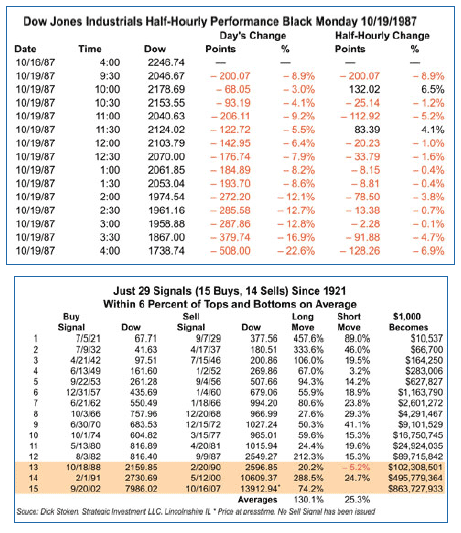
Twenty years ago last month we issued a timely Sell Signal in our October 1987 issue dated 9/23/87 one month before the Crash. The signal came from the illustrious Dick Stoken, whose research, books and timing we had been following for years. We called on our old friend this month to get an update on his system and to see if it was signaling any ominous tidings. It is not.
The accompanying table is an update of what was published in our newsletter at the time. We were pleased to hear the system has been tweaked yet remains sound. In response to the changing global economic landscape his system includes German and Japanese treasury bonds as well as the U.S. long bond.


