INVESTOR OPTIMISM REMAINS DOWN IN OCTOBER
Worries Rising about Personal Portfolios and Declining Dollar; Hopes Rising for US
Economy
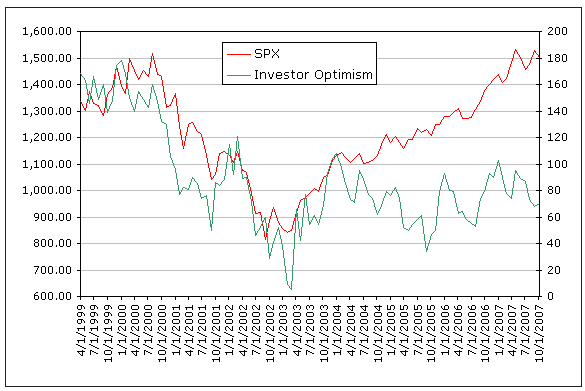
NEW YORK, October 22, 2007 – Investor optimism remained essentially unchanged for the
month of October rising just two points to a level of 70, according to the UBS/Gallup Index of
Investor Optimism. But the Personal Dimension of the Index, which measures investors’
optimism about their own investment portfolios, tumbled sharply by 8 points to 62 from 70 in
September. The Index is conducted monthly and had a baseline score of 124 when it was
established in October 1996.
Investor pessimism regarding the declining value of the dollar grew in October with 39 percent
of investors saying they believe that the value of the dollar is hurting the current investment
climate “a lot.” This is up significantly from the 30 percent who felt this way in September and
is the highest level of investor concern about the dollar since tracking began in March 2004.
These concerns about personal portfolio performance and the dollar may translate to less
holiday spending, as 27 percent of investors say they will spend less this holiday season than
last. This compares to 24 percent who said they would spend less the last time measurement
took place in November 2005.
In contrast to investor pessimism about personal portfolios and the dollar, the Economic
Dimension of the Index, which measures investors’ feelings about the direction of the overall
US economy improved dramatically, jumping 10 points from -2 in the month of September to
+8 in October. This leap in optimism suggests that the Fed’s cut in interest rates made
investors somewhat more optimistic about the direction of the economy over the next 12
months.
“The Fed cut has improved investor sentiment and the prospects for continued economic
expansion, but the effects of the subprime fallout will likely be felt for many months to come,”
said Mike Ryan, Head of UBS Wealth Management Research, Americas.
In spite of oil prices recently exceeding $80 a barrel, investor worries regarding higher energy
prices fell five percentage points in October with 60 percent saying they believe energy prices
are hurting the current investment climate “a lot.” Energy prices continue to top the list of
investor concerns but are currently at a much lower level than they were earlier this year.
Housing and real estate worries continue to concern investors with 51 percent saying they
believe the potential for a housing or real estate crash in some local markets is hurting the
investment climate “a lot.” This is down from the 55 percent who felt this way in September
but a sharp jump from the 41 percent who felt this way as recently as July.
Investors continue to see no bottom in sight for the housing and real estate markets with 78
percent saying they believe economic conditions in the national residential real estate market
are getting worse. Sixty-three percent of investors say conditions in their local real estate
markets are worsening, down just slightly from the 65 percent who felt this way in September.
Investors continue to fear that the problems in the subprime mortgage market will spread,
with 61 percent feeling there will be a spillover into the overall mortgage market. The credit
crunch continues to squeeze consumers with 65 percent saying it is harder for Americans to
get credit now than it was three months ago. Forty-three percent of investors now believe the
consumer crunch is hurting the investment climate “a lot.”
These findings are part of the 115th Index of Investor Optimism, which was conducted
October 1-14, 2007. To track and measure Index changes on an ongoing basis, new
samplings are taken monthly. Dennis J. Jacobe, Chief Economist for Gallup, said the
sampling included 804 investors randomly selected from across the country. For this study,
the American investor is defined as any person who is head of a household or a spouse in
any household with total savings and investments of $10,000 or more. Nearly 40 percent of
American households have at least this amount in savings and investments. The sampling
error in the results is plus or minus four percentage points.
For more than 60 years, the Gallup Organization has been a recognized leader in the
measurement and analysis of people’s attitudes, opinions and behavior. While best known
for the Gallup Poll, founded in 1935, Gallup’s current activities consist largely of providing
marketing and management research, advisory services and education to the world’s largest
corporations and institutions.
UBS is one of the world’s leading financial firms, serving a discerning international client
base. Its business, global in scale, is focused on growth. As an integrated firm, UBS creates
added value for clients by drawing on the combined resources and expertise of all its
businesses.
UBS is the leading global wealth manager, a top tier investment banking and securities firm,
and one of the largest global asset managers. In Switzerland, UBS is the market leader in
retail and commercial banking.
UBS is present in all major financial centers worldwide. It has offices in 50 countries, with
about 39% of its employees working in the Americas, 34% in Switzerland, 17% in the rest
of Europe and 10% in Asia Pacific. UBS's financial businesses employ some 80,000 people
around the world. Its shares are listed on the SWX Swiss Stock Exchange, the New York
Stock Exchange (NYSE) and the Tokyo Stock Exchange (TSE).
Additional information about the Index of Investor Optimism can be found at
www.ubs.com/investoroptimism
UBS Index of Investor Optimism Overall Trend