



***Market Summary***
The stock market is caught between a rock and a hard place. The rock represents relative weakness in the Consumer Discretionary and Finance sectors as well as the 90% down day last week. The hard place represents relative strength in Technology, bullish seasonals and a Fed rescue. Things could come to a head next week.
Right now, I think the negatives outweigh the positives. Relative weakness in Finance sector, Consumer Discretionary sector, Banking Industry and Retail Group is not something to be taken lightly. In addition, I have yet to see a strong advance to counter the 90% down day we saw last Friday. AD Net% and AD Volume Net% were below –90% in SPY and QQQQ last Friday. We could get a strong surge next week, but let's see some evidence before acting.
***Technical Highlights***
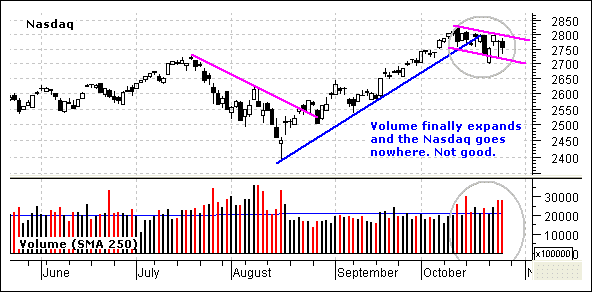
~Mister Mixed Up~ The market finished mixed on Thursday, but not in the normal fashion. Instead of leading the market higher, the Nasdaq 100 ETF (QQQQ) weighed the market down and finished 1.34% lower. The Russell 2000 ETF (IWM) was also lower and small-caps were weak. Large-caps propelled the S&P 500 ETF (SPY) and Dow Industrials ETF (DIA) to small gains. Volume was slightly above average on the NYSE and well above average on the Nasdaq as selling pressure picked up in tech-land. Seven of the nine sectors were higher with the Utilities SPDR (XLU) leading the way. The Consumer Discretionary SPDR (XLY) and Finance SPDR (XLF) were down and these two remain the biggest drags on the market. On the chart below, the Nasdaq basically consolidated the last 11 days and volume was above average. Volume on the advance was low and this is backwards. It should be high volume on the advance and low volume on the consolidation. Nevertheless, a break above flag resistance at 2800 would be bullish.
~Bullish Seasonals~ Charles Kirk of the thekirkreport.com noted the following from Jason Goepfert of sentimenttrader.com:
"Holding the S&P 500 during the last three days of October through the first three days of November has given a positive return during every year of existence of the S&P 500 tracking fund, SPY. The 12 out of 12 winning trades returned an average of +3.3%, with an average drawdown (i.e. maximum loss) of only -0.7% compared to an average maximum gain of +3.6%. That kind of thing shouldn't be ignored."
In addition, we are entering the most bullish six months of the year (November to April). Seasonals are interesting, but we must match the seasonal patterns with price action and trend. Seasonal tendencies are just one indicator and I do not recommend stand-alone indicators. Goepfert and Kirk probably don't either. This is just one more thing we can throw into the mix for next week. One top of the bullish seasonals, we have the FOMC announcement on Wednesday (31-Oct) and the employment report on Friday (2-Nov). The bullish case is pretty clear. The seaonals are bullish, the Fed comes riding to the rescue on Wednesday with a big rate cut and the employment report shows steady jobs growth. Needless to say, this could fuel a big rally and traders should be on their toes. Let's see some buying interest first through. Bob Pisani of CNBC notes:
Traders seem to have a near-messianic belief that the coming rate cuts (and many believe that the Fed will cut 100 basis points between now and the next three or four meetings) will help housing, stimulate capital spending, improve business confidence, and cure cancer. Still, what really has to happen is that financials and to a lesser extent consumer discretionary stocks (retail, home builders) have to find a bottom. Earnings estimates have been coming down for both of these groups in the fourth quarter; markets will remain jittery until we get a little more finality here.
Bob seems to get it. Pumping money and cutting rates do stimulate, but it does not matter until we see a bottom in some of the key sector and industry group ETFs (Finance, Banks, Consumer Discretionary and Retail). Buying stocks moves the market, not monetary policy. Let's see some proof in the pudding.
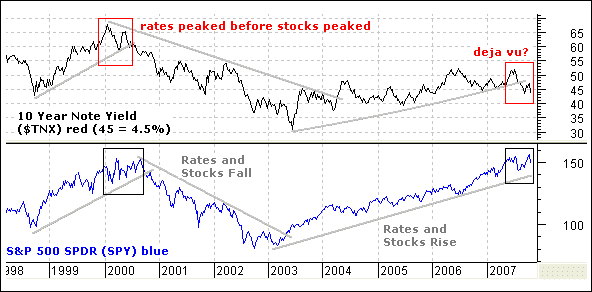
~Do Rates Really Matter?~ The chart below shows a positive correlation between interest rates and the stock market over the last 10 year. Yes, you read right. Both rates and stocks fell from 2000 until 2002. Rates and stocks rose from 2003 until 2007. It gets even more interesting. The red box in 2000 shows the 10-Year Note Yield ($TNX) forming a lower high and this preceded the stock market peak (black box) by a few months. The red box in 2007 shows a lower high for TNX and a break below 45 (4.5%). Rates have already peaked, but the stock market is still moving higher. If 2007 plays out like 2000, we can expect the stock market to peak soon and start moving lower. Perhaps the market has already peaked. On a separate, but related note, maybe Ron Paul is on to something when he says he wants to abolish the Fed!
~ETF Highlights~ In this next section, I will run through some key ETF charts and setups that are currently working. The chart is first and there is some brief commentary below.
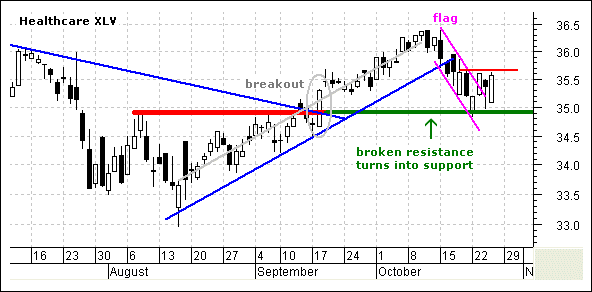
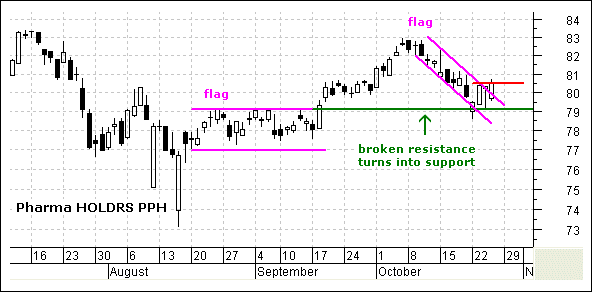
The Healthcare SPDR (XLV) and Pharma HOLDRS (PPH) both opened weak and closed strong to form bullish engulfing patterns. Both formed falling flag patterns and found support near broken resistance. Flag breakouts would be bullish. Within the ETFs, Eli Lilly (LLY) declined sharply and weighted, but Bristol Meyers (BMY) gapped up and led the way higher. Wyeth (WYE) also broke consolidation resistance.
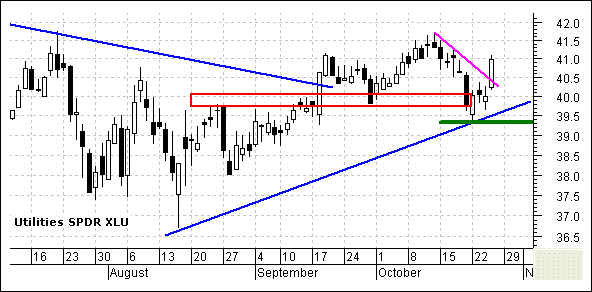
The Utilities SPDR (XLU) also found support near broken resistance and surged yesterday. The ETF gapped up, formed a long white candlestick and broke the magenta trendline. This affirms support around 39.5. Utilities are defensive plays that will benefit from lower interest rates because of their high levels of debt.
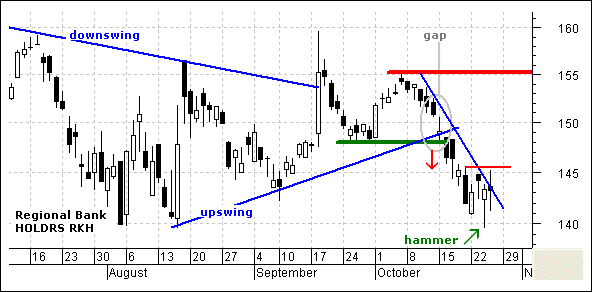
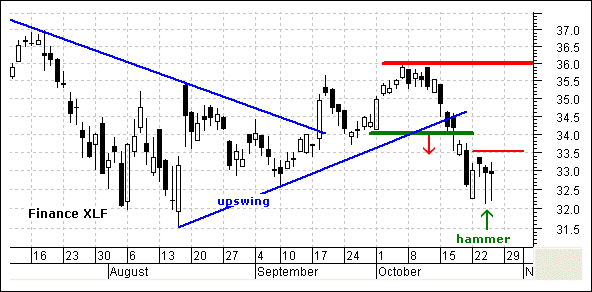
The Regional Bank HOLDRS (RKH) and Finance SPDR (XLF) stalled over the last four days and traders should watch these two closely in the coming days. The Finance sector is at the heart of the current credit crisis and it is not going away as long as these two ETFs show relative weakness. RKH and XLF formed are finding support near their August lows and a break above this week's high would be short-term bullish. "Short-term" is the key. The medium-term trend is clearly down and any rally from there would be deemed an oversold bounce. The Fed is pumping money and cutting rates to save this sector, but Wall Street is not buying yet.
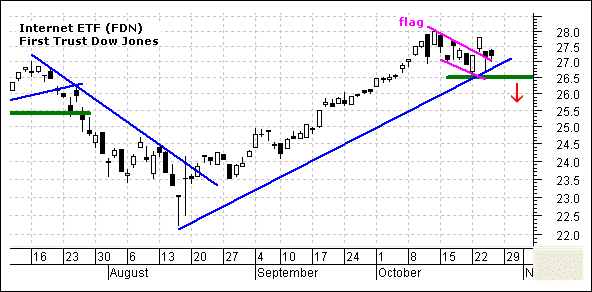
The Internet ETF FirstTrust (FDN) has been a top performer since mid August and this key ETF broke falling flag resistance with a gap up on Tuesday. Even though FDN moved back into the gap zone, the ETF closed above the flag breakout the last two days and support at 26.5 is holding. I find the ETF overbought after a 21% run, but the overall trend is still up and the flag breakout should be considered bullish until proven otherwise.
~Inter-Market~ Gold, bonds and oil are the strongest of the five inter-market groups and all three are trading at their highs for the year. What a strange trio. The positive relationship between gold and oil is completely understandable. Rising oil fuels inflationary fears and this pushes gold higher. Bonds loathe inflation, but continue to rise and it seems that bonds see something worse than inflation on the horizon (credit market woes or recession).
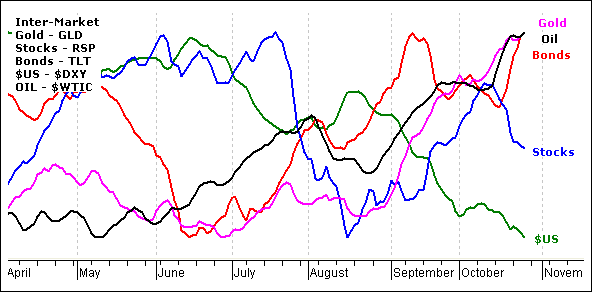
Stocks decoupled from bonds and moved sharply lower the last two weeks. I am using the S&P 500 Equal Weight ETF (RSP) as my proxy for stocks and this index does NOT favor a handful of large-caps. While large-caps are doing OK, the "average" stock is not holding up as well. Finally, the U.S. Dollar Index remains under intense pressure form rising oil, inflationary fears and the prospect of lower interest rates. Wow, think about that one for a minute. Interest rates are under pressure from slowing growth and inflationary pressures are increasing from rising energy costs. This is not a good combination.
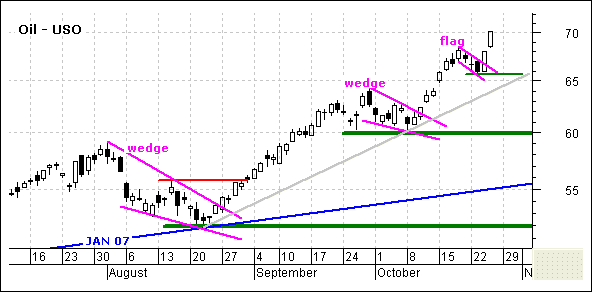
The United States Oil Fund ETF (USO) broke flag resistance with a surge on Wednesday and continued higher on Tuesday. Thank you Turkey, thank you Nancy (Pelosi) and thank you supply constraints. West Texas Intermediate Crude ($WTIC) is trading above $90 today (+1.05) and USO is surely going to move higher again today. The August trendline and mid October lows mark support at 65 and the bulls rule as long as this level holds. At some point rising oil prices are going to start hurting businesses and consumer, if not already.
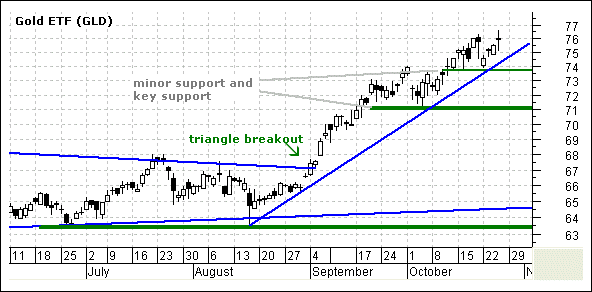
The streetTRACKS Gold ETF (GLD) is taking its cue from oil and remains strong. The ETF gapped down to start the week and then surged right back to last week's high. What a show of strength. I still find the ETF overbought, but the trend shows no signs of weakness and this overbought ETF may continue overbought. Watch minor support at 73.6 for signs of weakness and key support at 71 for a trend reversal.
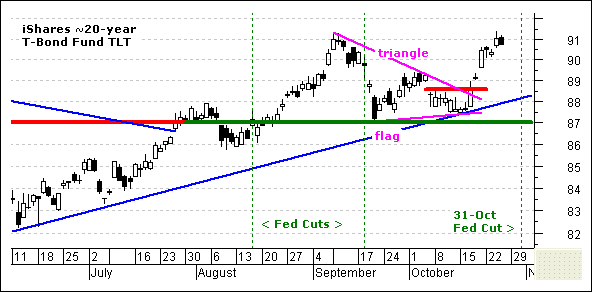
Bonds surged over the last two weeks as money moved into relatively safety. Treasury bonds are the closest you can get to a risk-free investment. The government will be the last thing to fall! The iShares 20+ Year Bond ETF (TLT) broke resistance in late July and August. Broken resistance turned into support and a triangle formed in Sept-Oct. The triangle breakout signals a continuation higher and bonds are the place to be when interest rates are falling. Key support is set at 87.
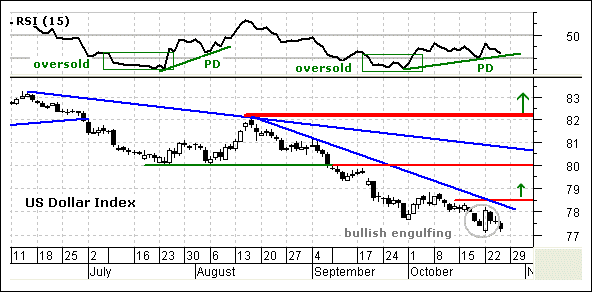
The U.S. Dollar Index ($USD) formed a bullish engulfing on Monday, but failed to follow through and fell back over the last three days. The bigger downtrend is simply too strong. A positive divergence formed in RSI and a move above 50 would be bullish for momentum. Be careful with this setup because it did not work well in early August and the breakout ultimately failed. The U.S. Dollar Index needs to break above 78.5 to get any kind of a short-term trend reversal. Such a move would be positive and call for a rebound towards broken support around 80. This would be considered a corrective advance within a larger downtrend.
Have a great weekend -Arthur Hill
---------------------------------------------------------------
Click here to post a comment, suggestion or question.
---------------------------------------------------------------
Disclaimer: Arthur Hill is not a registered investment advisor. The analysis presented is not a solicitation to buy, avoid, sell or sell short any security. Anyone using this analysis does so at his or her own risk. Arthur Hill and TD Trader assume no liability for the use of this analysis. There is no guarantee that the facts are accurate or that the analysis presented will be correct. Past performance does not guarantee future performance. Arthur Hill may have positions in the securities analyzed and these may have been taken before or after the analysis was present.
--------------------------------------------------------
about: The Daily Swing is posted every trading day around 6AM ET and focuses on short-term strategies for QQQQ, SPY and IWM. In addition, at two stock setups are featured every day with a detailed trading strategy. As warranted, coverage extends to broad market topics, key sectors and industry groups and inter-market securities (gold, bonds, the Dollar and oil).
--------------------------------------------------------
Sources: Data from Bloomberg.com, CBOT.com, Kitco.com and ino.com; Charting from Metastock (equis.com). Closing data from Reuters.com, eSignal.com, MS QuoteCenter and Yahoo! Finance.


