



HOME OF "PICTURES OF A STOCK MARKET MANIA" January 5, 2010
Alan M. Newman's Stock Market CROSSCURRENTS
Alan M. Newman, Editor
Brief Excerpts from our Special Year Ahead January 4th issue
Rationales & Targets
As forecast in our last issue, we got our "brief and modest move to new highs," and we are now looking for the "swift and shocking reversal" to commence. However, Friday's last hour swoon might have just been last minute profit taking and we will instead rely on key levels to determine the odds for the correction finally getting underway. On the hourly charts, there are a series of bottoms just above Dow 10,200 dating back to November 12th. When this level breaks, we should be on our way and accelerate down to anticipated support between 8100-8400. We do not see the Dow testing the March '09 bottom unless there is a catalyst at least as significant as the crisis that took us to the precipice last year.
The psychological aspect is fascinating. Given the fundamental background of a near economic and financial collapse, to see investment advisors at their least bearish in 22 years is just mind numbing. The economy requires jobs. Each decade from the 40s to the 90s witnessed at least 20% growth in payroll employment. There was ZERO job creation in the 00s. We expect recognition of this plight to soon surface.
SPECIAL SHORT TERM OFFER
YOUR COST IF YOU RENEW FOR A YEAR = ZERO! The Odds
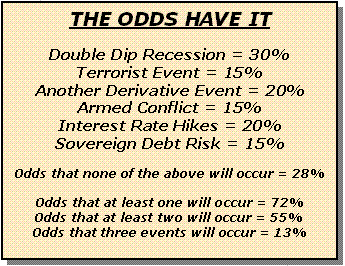
The highest odds scenario we offered for last year was 30% for the recession to worsen and clearly, it did. A "double dip" return to recession is again our biggest fear and highest odds scenario. Despite the modest gains for the economy in late 2009, we have reason to suspect that there was a bit of illusion created by the inevitable rebound from the abyss. As we have stated before, business is not good, it is just less bad than before. The consumer is not well heeled, just less strapped than before. A double dip into recession is quite possible.
We have raised the odds for a major Terrorist Event from 10% to 15%. While we would like to believe the odds grow smaller over time, the reports of terror episodes in other countries have not abated. It is likely only a matter of time before we suffer a disaster that while not on the scale of 911, may temporarily bring a large segment of our commerce to a halt.
We have increased the odds of another derivative event to 20%. We have conclusive evidence that the skew provided by credit default swaps (CDS) and collateralized debt obligations (CDOs) incentivized parties to create uncertainty where none existed or to dramatize and exaggerate uncertainties to profit from short sales. We need go no further than a recent NY Times article on the debacle that nearly took the country to ruin (see http://tinyurl.com/yejhqgd). As well, we hasten to reference David Einhorn's October 19th speech to the Value Investing congress (see http://tinyurl.com/ykcb3m5) wherein he claimed, "trying to make safer credit-default swaps is like trying to make safer asbestos." As you can see at bottom left, the $136 trillion in notional values for SWAPS comprises roughly two-thirds of all derivatives, and their share is still growing. Over the years, we have continually referred to a worst case of 1% to 2% of notional values at risk. Losses thus far from the 2007-2008 disaster are within that range. The risks remain in place. As always, it's not a question of if, but when.
Armed conflict remains at 15%. The principal trouble spots appear to be limited to insurgencies but we worry about a re-ignition of an Iran-Iraq conflict that would disrupt fuel supplies as Iran's radical leadership attempts to re-focus opposition within the country. Clearly, U.S. forces are already spread too thinly and any further confrontation would likely cause the markets great concern.
There is also a modest chance that the Federal Reserve will at some point be forced to raise interest rates, even if the economy remains under pressure. Add to the mix the odds of debt implosions, such as those seen in Iceland, Greece, Dubai, Spain and others, and we have the backdrop for increased uncertainty and the possibility of sovereign debt problems. Uncertainty is never good for stocks.
Bullion Bull
We've shown the chart below before but this time we are basing our comparison from our belief that bullion's bull market commenced with the terror of 911. Stocks were already well on their way to a bear market bottom, thus have had ample time to recover from the excesses of the tech mania. Trouble is, the tech mania was followed by an institutional mania and the subsequent popping and dénouement catalyzed by derivatives created sufficient uncertainty to guarantee an enormous interest in gold, not only from investors but from central banks. Gold has functioned as currency for thousands of years. Despite the many attempts of a fiat world to devalue gold via paper, bullion remains a final resort when doubts form.
Since 911 and adjusted for the effects of inflation, stocks as measured by the Dow are actually down 13.5% from the end of August 2001 while bullion is up a staggering 230%. Recently, as gold moved briefly above $1200 per ounce, there was much speculation that the surge was a blowoff. Not even close. In the blowoff of January 1980, bullion exploded, nearly doubling in only one month. Gold's 27% rise in the last four months and the subsequent correction that has erased most of the rise is in our view, very healthy bull market action. From our perspective, there are so many fundamental problems working at the same time that the potential upside for gold remains far higher than anyone realizes. While we see major resistance between $1800-$1900 per ounce, a move to those levels is not out of the question for 2010.

INTERESTED IN PERSPECTIVES YOU'LL FIND NOWHERE ELSE?
ENROLL IN OUR FREE TRIAL. NO OBLIGATION.
WATCH THIS SPACE FOR MORE COMMENTARY ON FEBRUARY 3rd.
WHY NOT REQUEST A FREE TRIAL? FREE TRIAL
Powerful Commentary. Unique Perspectives.
ABOUT ALAN M. NEWMAN
Alan M. Newman has been the Editor of CROSSCURRENTS since the first issue was published in May of 1990. Mr. Newman is also a member of the Market Technician's Association and has been widely quoted for years by the financial press, media, and other newsletters and has written articles for BARRON'S.
The newsletter is published roughly every three weeks and focuses on economic and stock market commentary, often covering controversial subjects. Several proprietary technical indicators are usually featured in every issue accompanied by current interpretation. Broad samples of our work can be viewed at http://www.cross-currents.net/.
Subscription rates are now $189 for one year and $100 for six months. A FREE 3 issue trial subscription is available by emailing us (click the "free trial" link above). Please note: trial requests must include name, address and phone number and must originate from the email address the trial is to be delivered. Trials are only available by Email (.pdf files). U.S. Mail subscriptions are available but include a nominal surcharge for postage and handling.


