



—THE CYCLES—
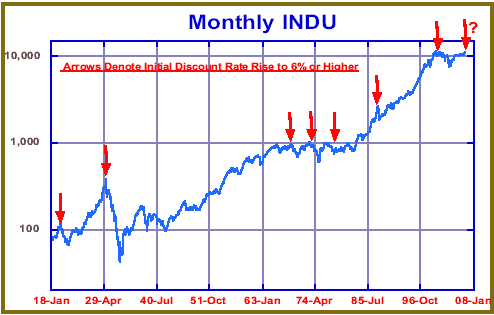
In our newsletter dated June 2nd, 2000, the front page chart was a monthly chart of the Dow Jones Industrial Average going back to December 1915 which used arrows to depict the seven occasions over that period of time when the Federal Reserve raised the discount rate to 6%. Over the years, it has generally been accepted that rising interest rates are bad for the stock market while declining interest rates tend to be good for the stock market. One of the great past masters of market analysis, Edson Gould, formulated buy and sell signals based on the number of times the Federal Reserve raised or lowered interest rates. For example, Gould formulated what he called the “Three Steps and a Stumble” rule with the three steps referring to three consecutive hikes in the interest rate by the Federal Reserve and the stumble referring to subsequent market action.
The current front page chart is an update to the chart of June 2nd, 2000. The last hike to 6% had occurred just weeks before that June 2nd, 2000 newsletter. The repercussions of a 6% discount rate were first brought to our attention by the talented people at Ned Davis Research. In their May 2000 Investment Strategy booklet, they presented a very similar chart with the main difference between their chart and ours being the the additional arrows which they presented on their chart to show where “Three Steps and a Stumble” sell signals were given over the past 80 years. Needless to say, there have been far greater than three hikes in interest rates over the past 3 + years and it would be easy to criticize the Edson Gould theory because the market has failed to pay the price for those interest rate hikes. One could rationalize that interest rates were lowered so dramatically that the interest rate cycle this time around has been very different and that difference has contributed to the market’s benign reaction, at least so far.
The front page chart, however, makes it clear that the absolute level of interest rates has been far more important than the relative rates that resulted from a predetermined number of interest rate easings and hikes. Whenever the Federal Reserve discount rate has moved up to 6% anytime over the past 91 years, it has never failed to stop any stock market rally virtually in its tracks. As you might note from the history of the prior seven occasions of this 6% phenomenon, not only has the market been stopped in its tracks but with only one exception, it has been dealt a blow that would last for several years to come. The one exception occurred at the discount rate hike to 6% on September 4th, 1987. At that time, the market rally once again was stopped dead in its tracks but one could argue that the market was making new all-time highs just two years later and continued to do so over the next decade. There is, however, another side to that story. Within seven weeks of the September 4th, 1987 discount rate hike to 6%, the Dow Jones Industrial average suffered one of the worst crashes in its history and endured a decline of over 40% from its August 1987 high to its October 1987 low.
Let’s examine the market action after the last rise to 6% on the discount rate. That occurred on May 16th, 2000, just over two weeks prior to the newsletter of June 2nd, 2000, that discussed the 6% phenomenon in detail. At that time, the market of choice for the vast majority of participants was the Nasdaq and, more specifically, the Nasdaq 100 (NDX) which is the index comprised of the largest 100 stocks in the Nasdaq Composite. When the Federal Reserve raised the discount rate to 6% on May 16th, 2000, the NDX closed that day at 3647. It had already declined 22% from its March 27th, 2000 all-time high. One might have thought that most of the damage had been done with that 22% decline. Those of you who saw our chart with the results that followed interest-rate hikes on the discount rate to 6%, however, were well prepared for what was to follow. Over the next 29 months, the NDX would decline a stunning 78% from that May 16th, 2000 close and 82.8% from its all-time high close of 4705 on March 27th, 2000.
Let’s fast-forward to April 2006. On March 28th, the Federal Reserve raised the discount rate to 5.75% in a pattern that has seen successive 1/4% hikes over the past two years. The Federal Reserve has not suggested the last hike was the final one. The next hike will take the discount rate to what has always been a destructive level of 6%. The fearsome fact that would accompany such a hike in the discount rate is that the NDX has barely recovered 25% of the ground lost between the March 2000 top and the October 2002 bottom. On the other hand, despite the uniformly disastrous results for the Dow Jones Industrial Average following discount rate hikes to 6%, the same has not been uniformly true for the Nasdaq Composite Index. If you are a bull, you would pray that the Nasdaq results would be similar to the results following the October 26th, 1977 rise in the rate. At that time the Nasdaq Composite moved to a closing low just over one week later, then began a rally which would never again look back at the October 26th, 1977 price low. The history of the past century, however, suggests that was a true anomaly. A discount rate of 6% has been one of the most reliable and consistent indications that the market faced two potential options. The first option would be to experience some type of market crash. Two of the prior rate hikes to 6% closely preceded market crashes. In 1929, the primary top preceding the crash occurred 25 calendar days after the initial move in the discount rate to 6%. In 1987, the secondary top preceding the crash occurred 28 calendar days after the initial move in the discount rate to 6%.
The second option based on the prior history of the Dow Jones Industrial Average in relation to 6% discount rates suggests the possibility of a relatively very long period of stock market under performance. One might argue we have already seen that over the past six years. That does not change the expectations based on
prior market history.
It is, of course, important to note that the discount rate has not yet been raised to 6%. We expect there is a very real chance that will occur before the end of this month but that is based on conjecture. Until the rate actually reaches 6 percent, the foregoing history is somewhat premature.
There is a fabulous market newsletter called Growth Fund Guide ( PO Box 6600,Rapid City, SD 57709), edited by Walter Rouleau. I do not know Walter personally but I must admit I have read his material on an intermittent basis for a few decades and I initiated a complimentary exchange of newsletters a few years ago because of my admiration of his work. The name of the newsletter is somewhat misleading because, although Walter does a great amount of work with individual mutual funds, it has always been his research and musings on the overall market picture that have most appealed to me. He does a great job in sifting through long-term historic patterns in an attempt to glean information that others might overlook. In his latest edition of Growth Fund Guide, his front page table shows some significant statistical conclusions regarding the 4 year cycle. The table goes back to 1896 and presents statistical data for the past 27 four year election cycles. There is a plethora of interesting information in the 4 year cycle table, but we will try to hit upon a few highlights.
The historical average of all Dow Jones Industrial Average 4 year cycle declines is 32.8%. We should emphasize that that is the average decline. There has never been a 4 year cycle decline less than 9.7% (1994) and the greatest percentage decline was 86.0% in the decline which ended in July 1932. One of the most consistent statistics is that, since 1962, all four year presidential cycle bottoms occurred in what is called the Mid-Term election years with the exception of 1987, the year of the crash. That means there is a strong statistical suggestion that 2006, a Mid-Term election year, will see an important market bottom.
Another truly impressive statistic from the Growth Fund Guide table is that the average rise out of the four year presidential cycle bottom produces gains of 97.4%. Rouleau points out, however, that the cycle bottom which occurred in October 2002 has so far produced a gain that is well below average (+ 54.2%). He goes on to state that all four year presidential cycle rises are likely to continue to be below average until the U.S. market once again becomes extremely undervalued. He hazards the guess that the upcoming 4 year cycle bottom is less likely to reach extreme undervaluation than the next 1 or 2 four year presidential cycle bottoms that follow. It is refreshing to still be able to hear intelligent analysts discuss the valuation picture as if it was still relevant. It is our contention that far too many analysts have been converted to the philosophy of relative valuation as opposed to absolute valuation. Proponents of relative valuation argue that price/dividend and price/book value and price/earnings valuations are far less important than relative valuations that are based on comparisons with interest rates.
It is our contention that because the market has gone for such a long period of time seemingly ignoring absolute valuation levels that the lesson will be brought home to them in a far more painful fashion than usual and before the market is ready to launch another long term bull market, absolute valuation readings will reach historically low levels.
—TECHNICAL INDICATORS—
[Reserved for Subscribers]
—MARKET PROJECTIONS—
As far as longer term projections are concerned, our most reliable projection generator, the New York Composite Index, has satisfied all upside projections including a nominal 4 year upside projection. That fact alone strongly suggests the next significant move in the market should be to the downside. On a shorter-term basis, the preceding paragraphs of this newsletter printed some of the short term projections that were met virtually exactly at today’s highs. Even higher projections could have been generated had the market remained up into the first hour of trading today, but when that failed to occur it became clear that downside risk was increasing substantially.
—MUTUAL FUNDS—
Rydex switchers bought the Rydex Tempest Fund at the March 8th morning price of 38.10. The fund was sold at the closing price of March 31st of 37.19 for a loss of 2.4% on the trade. Fidelity Select switchers bought the Fidelity Select Gold fund at the 10:00 a.m. Eastern time price of 35.59 on March 21st. We have two diifferent specific model portfolios-14 Fidelity Select switchers and one for Rydex Group switchers. How you distribute your own portfolio is up to you as an individual.
NOTE: We would like to remind subscribers that we are now managing money through the use of mutual fund timing. This relieves you of the stress of wondering whether you missed a signal or whether you will reach your fund in time to make a switch. Our management company is called, appropriately enough, “Stockmarket Cycles Management, Inc.” If you would like additional information regarding this service, please call the office (800) 888-4351 or e-mail us at suedavy_smc@comcast.net anytime.


