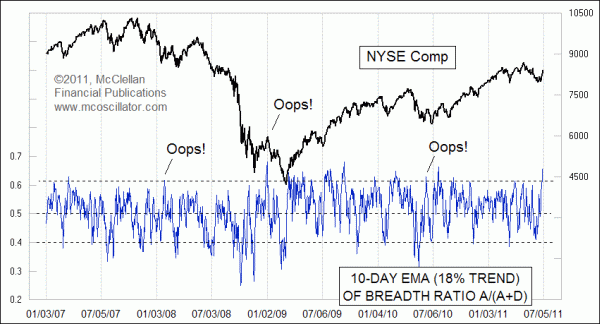

Many of the definitions you find online of the Zweig Breadth Thrust I have not seen anyone trace back to any Zweig's writings. This stuff about when a 10-day EMA of (advancers / total issues) goes from 40 to 61.5 being a Zweig Breadth Thrust, for example, I call B_S - until I actually see someone trace it back to Zweig's writings, and I have yet to see that happen.
How did Zweig actually define the Zweig Breadth Thrust according to his very own writings, and not what people have ascribed to him without reference?
I've gone ahead and taken the time to scan a couple of pages from his 1986 publication, "Winning on Wall Street":

In other words, Zweig defined a Zweig Breadth Thrust as a 10-day period where the total number of advancers outnumber the total number of decliners by a 2:1 ratio. This can also be defined as a 10-day period where ADT10 > 66.6667.
*ADT10 = (Sum of Advancers Over Past 10 Days) / (Sum of Advancers Over Past 10 Days + Sum of Decliners Over Past 10 Days)
What is the Real History of Zweig Breadth Thrusts?
The Zweig Breadth Thrust was originally applied by Zweig to the NYSE Composite. Back then, the NYSE Composite was not polluted with so many non-operating components (as it has been over the past 10 or so years) and almost entirely (if not entirely) consisted of common stocks (sort of like the S&P 1500 of today). Here is the history of Zweig thrusts on the NYSE Composite based on a report from the MTA that I have:

Sorry, I don't have data for Zweig Breadth Thrusts on the NYSE Composite past 2009.
[I no longer keep track of NYSE historical data and have focused on SPX historical data instead, since the latter by policy should never include non-operating components. Backtesting has revealed that breadth thrusts on the SPX of all kinds (not just Zweig's) are just as useful and have just as good performance (with negligible positive or negative differences on occasion) as breadth thrusts of the past on the NYSE Composite (and breadth thrusts on the SPX are in fact more useful, as compared to the NYSE Composite, I would argue, since the SPX has so many large companies and they happen to be the real market movers due to the major indices being market cap weighted - whereas the NYSE Composite still has many more small companies than medium and large companies combined, never mind the pollution today caused by non-operating components which are mainly interest-rate sensitive, like bond funds.]
Just How Important is the ADT10 That Zweig Kept Track Of?
You tell me:

Edited by alysomji, 02 July 2011 - 02:20 AM.