

Site Navigation



Advertisement

Brasilian stock market down 15%, celebrating the communis...
Communism is freedom and prosperity................for the few belonging to the gang, slavery and poverty for the rest of population.


122 Views ·
0 Replies

Careful Being Long Today, Wave Structure Bearish VST into...
A potential huge gap down Tuesday possible. With Venus and Mercury now Retrograde and today being a Full Moon with the Sun sq. Pluto, and in addition the wave structure just sported a double w-x-y Y wave rally of a larger "B" wave of [X] of (Y) of {Z}, a move down to around 7537 SPX now possible early Tuesday. The (Y) wave of {Z} looks like a 2-5-2 TD affair, that is 2 TD's up [W], 5 TD's down: a "complex x-y-z A w-x-y B a-b-c C [X]" then the [y] wave of (Y) into early Thursday. [Z] of {Z} to the downside finishes early Monday the 2nd of Nov, a 32+1 TD Gann low. {X} = 25 TD's, {Y} = 18 TD's and {Z} = 19 TD's. This complex pattern finishes a larger "B" wave of a larger (Y) wave. "C" would then be due early Nov 12 and then the crash begins.
150 Views ·
1 Replies
( Last reply by blustar )

Been watching this guys work for a while, he'd pretty...
241 Views ·
0 Replies

Turn Window for the Week of 26 October & a Roosevelt...
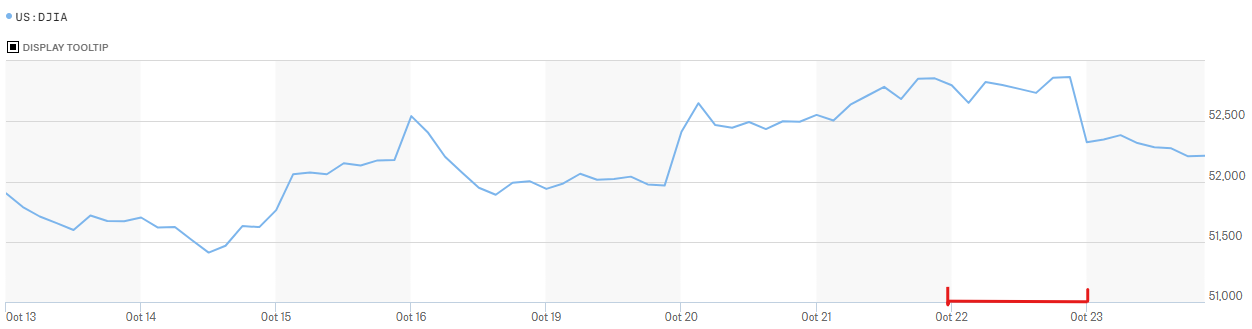
According to my turn probability summation system, the day this coming week with the highest likelihood of seeing a turn in or acceleration of the current trend in the DJIA is Thursday October 29th, but the summation values for the rest of the week are so high that other turns of some importance are likely.
Last week the Thursday the 22nd turn window tagged a high of some degree depending on action early this coming week. The whipsaw action that I thought might occur was just a run up then a run back down.
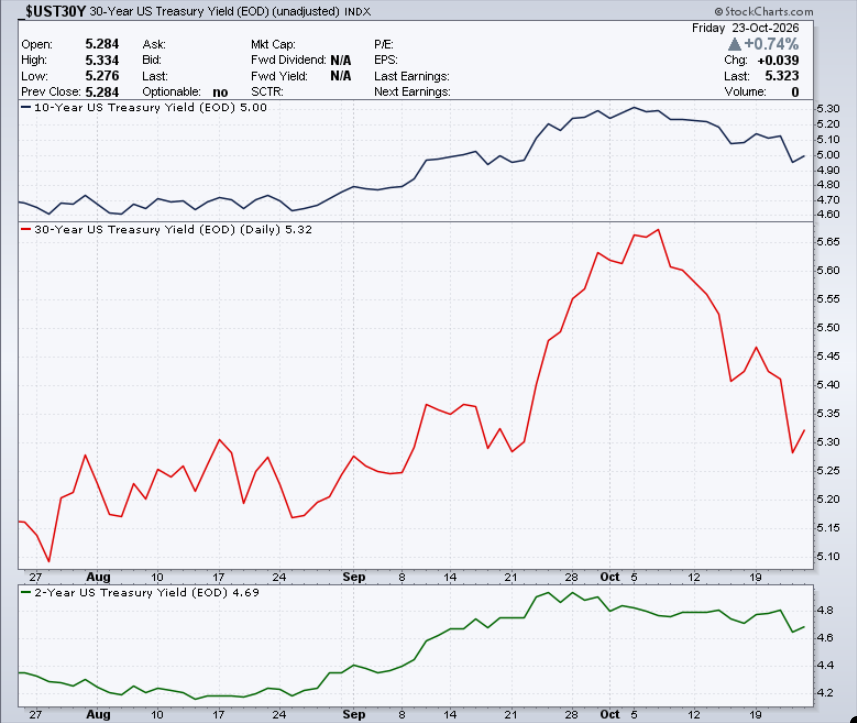
This coming Wednesday I suspect we'll get another episode of Fed talk and no action. Warsh's reinterpretation of Theodore Roosevelt's charge to speak softly and carry a big stick in which Kevin talks tough and carries a big balance sheet doesn't exactly seem to be having the desired effect on inflation. At some point he's going to have to concede 3% is the new 2% or just admit that in a 2 trillion dollar deficit world with a 40 trillion dollar debt, folks are just going to have to endure inflation for the greater good, that is for the good of wealthy asset holders like him that is. At this rate instead of babbling about the "K" economy, pretty soon the pundits on the tube will start talking about the "T" economy with everything at the top and nothing on the bottom.
For the last two weeks the bond and note market have been in a bell ringing rally. Either my little whinge above about the Fed is completely off base and Kevin is a genius, or the economy is about to turn down sharply solving his inflation problem. Me being wrong is probably the safe bet, but with the next stock market high risk window only about a week away, I am not going to don the dunce hat just yet.
Regards,
Douglas
288 Views ·
2 Replies
( Last reply by Douglas )
Be careful out there, I don't think anybody wants a b...
The boyz have an excellent set up so far to lower the boom with a big gap down Monday AM forcing some retail capitulation. (JMHO)
177 Views ·
3 Replies
( Last reply by GDA )
- 945,820 Total Posts
- 3,188 Total Members
- Michael Lu Newest Member
- 64,537 Most Online
8095 users are online (in the past 60 minutes)
2 members, 8093 guests, 0 anonymous users (See full list)
Facebook, Bing, Google, andr99, harry5

